



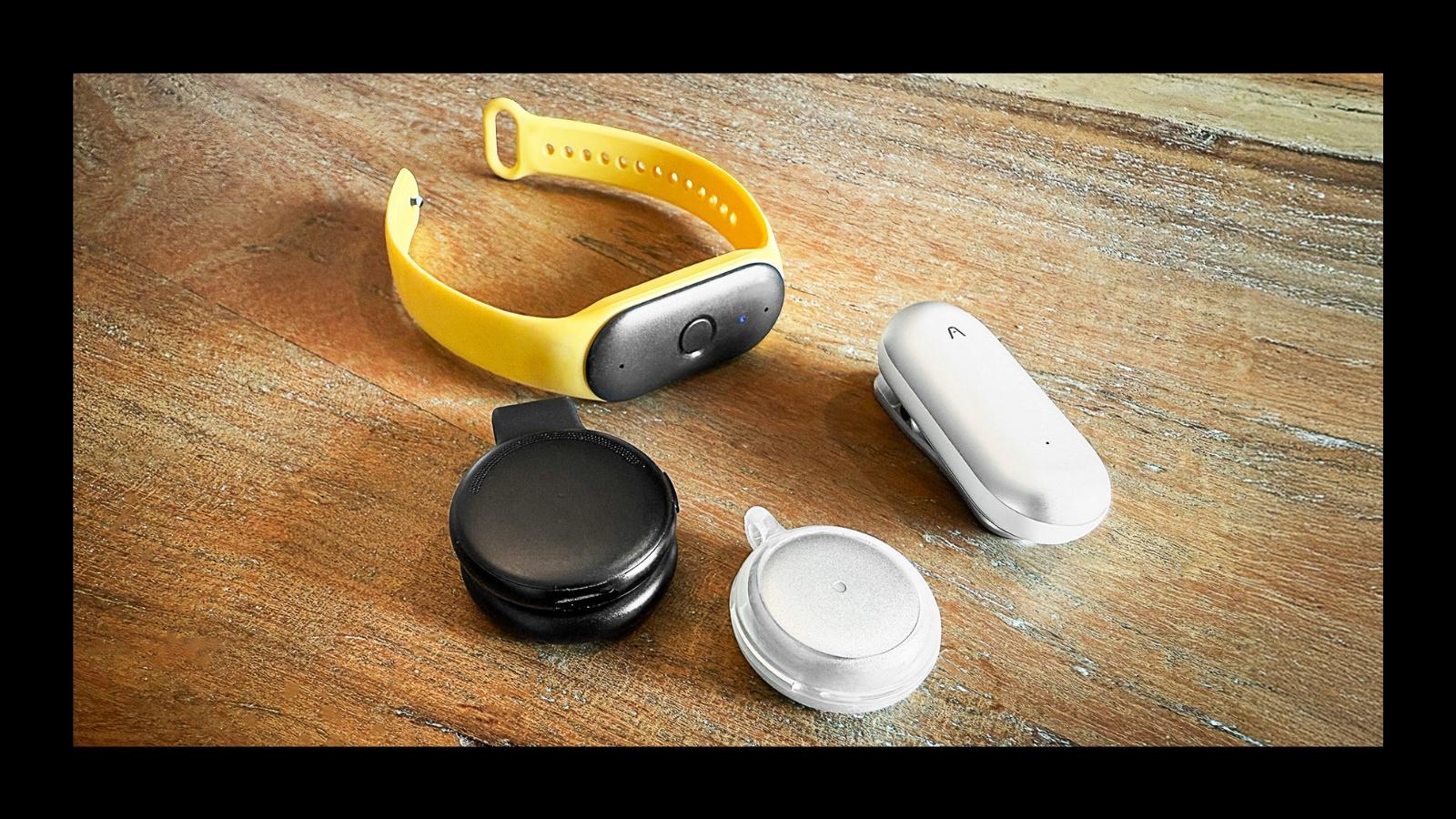
The best AI wearable in 2026 depends entirely on what you are trying to stop losing. For capturing everything said around you all day, an ambient AI pendant is the right shape. For meetings you choose to record, a press-to-start clip like the Plaud NotePin S is cheaper and cleaner. For discreet notes to yourself, the Sandbar Stream ring. For anything requiring vision, Ray-Ban Meta glasses. This guide ranks the category by job rather than crowning a single winner, because a single winner does not exist yet. If you already know a pendant is the shape you want, our pendant-specific pick is Best AI Pendant 2026: Every Model Compared.
Best AI Wearables 2026 at a Glance
| Device | Type | Price | Subscription | Best for |
|---|---|---|---|---|
| Legend | Pendant, always-on | $499 USD (includes first year) | $499/year after | Ambient memory, ADHD |
| Plaud NotePin S | Pin, press-to-record | $179 | Free tier, Pro $99.99/yr | Meetings and accuracy |
| Bee (Amazon) | Wristband or clip, always-on | $49.99, published by Bee | Formerly $19/mo, current status not published | Cheapest entry point |
| Omi | Pendant, always-on | $129 (limited-time price, list $179) | Free tier with 300 cloud minutes/mo, Plus $19/mo, Unlimited $29/mo | Developers and tinkerers |
| Friend 2.0 | Pendant, companion | $249 | $10/mo optional | Companionship, not notes |
| Sandbar Stream | Ring, press-to-talk | $249 | Free tier, $10/mo Pro | Capturing your own thoughts |
| OASIS 1 | Ring, press-to-talk | $289 | None announced | Replacing keyboard input |
| Ray-Ban Meta | Glasses | From $299 | None | Anything visual |
Best for Ambient Memory Capture: Legend
Verdict: Buy Legend One if you have ADHD, or simply lose what people tell you, and want always-on capture with no button to press, at $499 including the first year of membership and $499 a year after that.
If the problem is that people tell you things and those things evaporate, you want a device that captures without being asked. Legend is a voice-first pendant worn at chest height, built specifically for people with ADHD. It turns your conversations into text, with no audio to play back and none kept in your account, and shows a Halo light whenever it is active so the people around you can see it. Three microphones handle more than 150 languages, and the day arrives as summaries and auto-generated to-dos in the Legend App. Roughly two days of continuous use on a two-hour USB-C charge. Here is how Legend works, from the pendant to the app.
At $499 including the first year of membership, then $499 annually, it is the most expensive device here. What you are paying for is the always-on capture with no trigger step, plus unlimited transcription and storage. If you would use it every day, the math works. If you want a device for occasional meetings, buy something cheaper.
Best for Meetings: Plaud NotePin S
Verdict: Buy the Plaud NotePin S at $179 if what you need is meetings and interviews that you choose to record and you are happy to press a button to start.
Plaud has the strongest reputation for transcript quality in the category, and publishes support for 112 languages with speaker labels, though it does not publish an accuracy percentage of its own. Its predecessor, the NotePin, won a Tom's Guide AI Award in 2025. At $179 with a free tier covering 300 minutes a month, it is also priced sensibly.
The catch is the same thing that makes it good: it is a press-to-record device. You decide when a session starts. That is ideal for meetings and interviews, and a poor fit for the hallway conversation you did not know was important until later. Pro runs $99.99 a year and Unlimited $239.99, so factor the subscription into any comparison.
Best Budget Pick: Bee
Verdict: Buy Bee at $49.99 if you are in the US, use an iPhone and want the cheapest way to try always-on capture, knowing its future subscription price is not published.
At $49.99 in hardware, Bee is by a wide margin the cheapest way into always-on AI capture, which makes it the obvious first purchase for anyone curious about the category and unwilling to spend hundreds to find out.
Be careful about treating that as the total cost. Bee publishes $49.99 for its Pioneer Edition. It does not publish a subscription price. The $19 monthly fee Bee charged before Amazon acquired it in July 2025 has been reported as dropped, though Amazon has confirmed nothing and a Premium tier has been signalled without pricing. Treat Bee's running cost as unknown rather than zero.
Set expectations on the hardware too. Advertised battery is seven days standby, but real-world active recording runs closer to a day and a half to two days. It remained iOS-only through mid-2026 with Android promised. And being owned by Amazon is either reassuring or disqualifying depending on how you feel about Amazon holding transcripts of your conversations.
Best for Developers: Omi
Verdict: Buy Omi at $129 (limited-time price, list $179) if you want an open-source, always-on pendant you can modify yourself.
$129 on omi.me as of 2 October 2026, a limited-time price down from its $179 list price, and genuinely open source across hardware, firmware, and app, with a plugin store and active GitHub community. If you want to modify what your wearable does rather than accept a company's product decisions, nothing else in the category comes close.
It is not the pick for someone who wants a polished consumer experience out of the box. It is the pick for someone who reads that sentence and thinks that sounds fine.
On running cost, the free tier covers 300 cloud transcription minutes a month plus unlimited on-phone transcription, Plus is $19 a month or $161.91 a year, and Unlimited is $29 a month or $269.91 a year.
Best for Companionship: Friend 2.0
Verdict: Buy Friend 2.0, at a reported $249, only if you want a pendant that talks with you through the day, not one that takes notes.
Friend is the outlier here, and deliberately so. Founder Avi Schiffmann has been explicit that it is not an assistant. The $249 second-generation model added a built-in speaker so the pendant talks back, with a randomly assigned voice and personality fixed at setup. Built on Google's Gemini, roughly 15 hours of battery, iPhone app, with an optional $10 monthly plan extending memory past the default 30 days.
Nobody should buy Friend expecting meeting notes. People who want an always-present conversational presence through the day are buying exactly what it sells, and it is the purest version of that idea available.
Best AI Rings: Sandbar Stream and OASIS 1
Verdict: Buy the $249 Sandbar Stream if you want to whisper thoughts to yourself and have them organized, or the $289 OASIS 1 if you want to dictate and edit text in place of a keyboard.
Both put a whisper-capable microphone on your finger, both skip health tracking entirely, and both are additions to your existing stack rather than replacements for an Oura.
The $249 Sandbar Stream is a capture device: press and hold, whisper a thought, and an AI assistant called Inner Voice organizes it. Backed by $36 million and a team out of CTRL-labs and Meta. The $289 OASIS 1 is an input device, carrying what Oasis calls the first 2D trackpad on a ring, so you can dictate a sentence and then edit it with the same finger across Mac, iPhone, and Vision Pro.
Dictate to think, buy Stream. Dictate to write, buy OASIS.
Best for Vision: Ray-Ban Meta
Verdict: Buy Ray-Ban Meta, from $299, if the job needs a camera and you accept that glasses are more conspicuous than a pendant or a ring.
If the job requires seeing rather than hearing, glasses are the only mature option. Meta's line now starts at $299, with a display-equipped model at $800, and the design problem is largely solved: they read as eyewear rather than gadgetry. Samsung and Google have intelligent eyewear coming with Gemini built in.
Understand what you are buying. Glasses excel at translating a menu, identifying a landmark, or capturing your point of view. They are considerably more socially conspicuous than a pendant or a ring, because a camera pointed at a room reads differently than a microphone.
Best If You Forget to Press Record: Legend
Verdict: Buy Legend One at $499, including the first year of membership, if the step you keep missing is pressing the button.
A press-to-record wearable captures nothing on the day you forget to press it. Legend One is always on with no button and turns your conversations into text, with no audio kept in your account. The honest downsides: there is no audio to play back, and at $499 a year after the first year it costs more than anything else here. Bee at $49.99 and Omi at $129 are cheaper always-on options with limits of their own: Bee ships to the US only, works on iOS only, and has announced a Premium subscription without a price, and Omi may store your audio, per its privacy policy.
What About Limitless and Humane?
Worth knowing before you shop the secondhand market. Meta acquired Limitless in December 2025 and halted Pendant sales, with support running through late 2026. Humane's AI Pin is discontinued entirely. Full replacement guide here: Limitless Pendant Discontinued: The Best Alternatives in 2026.
This is the defining risk of the category right now. Three of the most talked-about devices from the last two years have been acquired or shut down. Before buying anything here, ask what happens to your transcripts if the company is bought, and whether the hardware keeps working without the service.
Browse AI Wearables by Type
Every AI wearable we have covered, grouped by the form it takes.
- Coming soon: Upcoming AI Hardware 2026: Every Announced Device, Ship Date and Price
- Pendants and necklaces: Best AI Pendant 2026: Every Model Compared, and Which to Buy
- Always-on wearables: Bee vs Omi (2026): Which Always-On AI Wearable Should You Buy?, Best Bee Alternatives in 2026: 6 Devices Compared, Taya vs Bee: Should Your AI Wearable Record the Room, or Just Your Voice?
- Clip-on recorders: Best Plaud Alternatives in 2026: 7 Devices Compared, What Is the SwitchBot AI MindClip? The $119.99 Clip-On Recorder, Explained, soundcore Work vs Plaud NotePin S: Which Worn Recorder Wins?, Plaud vs Pocket AI (2026): Which Recorder to Buy, What Is Vibe Dot? The $199 AI Recorder, Explained
- Rings: Sandbar Stream vs OASIS 1: Which Whisper-Input Smart Ring Should You Buy in 2026?, Pebble Index 01 vs Sandbar Stream: Which Voice Ring Should You Buy?, Garmin CIRQA Ring vs Oura Ring: Should You Wait for Garmin's Smart Ring?
- Glasses: RayNeo iO vs Meta Ray-Ban Display: Which AI Smart Glasses Should You Buy?, iFLYTEK AI Glasses vs RayNeo iO: Which Translation Glasses Should You Buy?, Where Are Meta Smart Glasses Banned? The Growing List, and Why Meta Is Building a Pendant Instead
- Pins, charms and keychains: Humane AI Pin Alternatives in 2026: What to Buy Instead, What Is Meta's Muse Charm? Everything We Know, Muse Charm vs. Starboy: Two Very Different AI Keychains
- Wristbands, watches and earbuds: What Is the Persona Band? The $179 AI Wearable, Explained, Persona Band vs Bee: AI Agent or AI Memory on Your Wrist?, What Is Apple Watch Live Rewind?, OSO AI Earbuds vs Plaud One Explorer Edition: Only One Is Actually On Sale, Apple AirPods With Cameras: What Apple's Own Leaked Video Reveals
- Before you buy: What Is an AI Wearable? How They Work, Types, and What They Are Good For, Are AI Wearables Legal? Recording Consent Laws by State, Explained, What Happens to Your Data When an AI Wearable Company Shuts Down?, Consent and AI Wearables: What Legend Expects You to Do
The Takeaway
Buy by job, not by hype. Ambient capture all day: a pendant, and Legend if ADHD or reliability is the driver. Deliberate meeting capture: Plaud NotePin S. Trying the category cheaply: Bee at $49.99, published by Bee. Thoughts to yourself, discreetly: Sandbar Stream. Keyboard replacement: OASIS 1. Anything visual: Ray-Ban Meta. Companionship rather than productivity: Friend 2.0.
The category's real dividing line is not price or brand, it is whether the device waits for you to trigger it. Press-to-record devices give you cleaner privacy and cost less. Always-on devices catch the thing you did not know mattered. You can compare AI memory devices on both sides of that line on one page. That distinction is why Legend is built the way it is: for people whose whole problem is that remembering to press the button is the step that fails, a device that needs to be triggered solves the wrong half of the problem.
Keep Reading
- Limitless Pendant Discontinued: The Best Alternatives in 2026
- Are AI Wearables Legal? Recording Consent Laws by State
- Is It Creepy to Wear an AI Pendant?
FAQ
What is the best AI wearable in 2026? There is no single winner. For ambient conversation capture, an always-on pendant like Legend. For meetings, the Plaud NotePin S at $179. For the cheapest entry, Bee at $49.99, published by Bee. For vision-based tasks, Ray-Ban Meta glasses from $299.
What is the cheapest AI wearable? Bee at $49.99, published by Bee. Its subscription was $19 a month before Amazon acquired it in July 2025, and while that fee has been reported as dropped, Amazon has confirmed nothing and Bee publishes no subscription pricing, so treat the running cost as unknown. Omi is next at $129 (limited-time price, list $179) and is fully open source.
Do AI wearables require a subscription? It varies. Legend includes the first year at $499 then renews annually. Plaud and Sandbar offer free tiers with paid upgrades. Omi has a free tier of 300 cloud minutes a month, with Plus at $19 a month and Unlimited at $29 a month. OASIS 1 has announced no subscription. Bee's fee was formerly $19 a month and its current status is not published.
Is the Limitless Pendant still available? No. Meta acquired Limitless in December 2025 and stopped selling the Pendant, with support continuing through late 2026.
Sources: Layer3Labs: Best AI Wearable Pendants 2026; Big Guy on Stuff: AI Wearables Review 2026; CNBC: Meta acquiring AI wearable company Limitless; CNBC: Meta announces new smart glasses starting at $299; TechCrunch: Friend returns with a new voice and a bigger price tag. Prices for Legend One, Plaud NotePin S, Bee and Omi were checked against each maker's own site and are current as of 6 October 2026.
Share:
What Is an AI Wearable? How They Work, Types, and What They Are Good For
Are AI Wearables Legal? Recording Consent Laws by State, Explained