


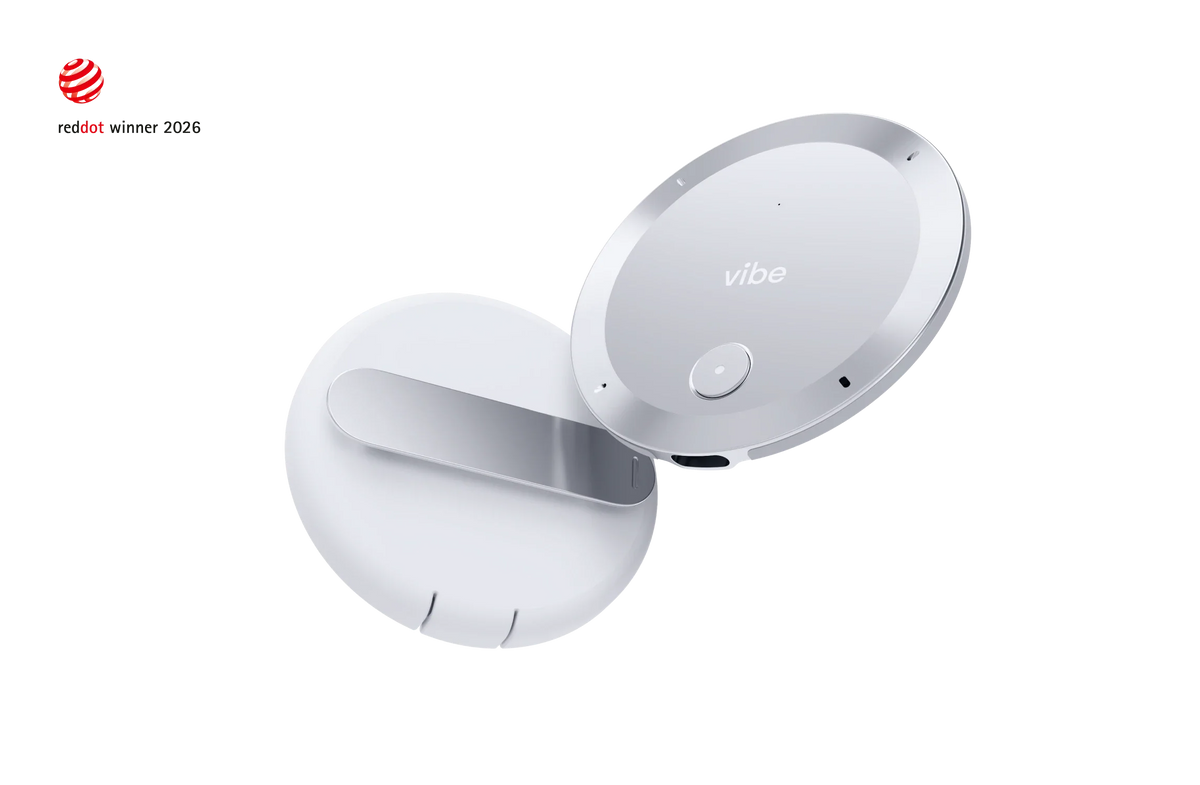
Vibe Dot is a $199 wearable AI recorder that captures conversations, transcribes them with speaker labels, and generates summaries and action items in a companion app. It is made by Vibe, better known for its collaboration displays, and it sits between the cheap always-on pendants and the press-to-record recorders because it can work either way. Here is what it does, what it costs, and the one feature you should not assume is finished.
| Spec | Vibe Dot |
|---|---|
| Price | $199, down from $249, which Vibe describes as 20% off |
| Battery | "30+hours non-stop recording" |
| Weight and size | 0.83 oz, 0.17 inches thin |
| Microphones | Five: four air microphones and one bone-conduction microphone |
| Storage | 64GB onboard |
| Capture | Press and hold, double-tap, or an automatic mode still in Beta |
| Audio | Kept. Stored locally, synced to the phone, then uploaded to the cloud |
| Plans | Starter free forever, Pro $9/month, Max $29/month |
| Warranty | 12 months, with a 30-day return window |
What It Actually Does
The loop is capture, transcribe, summarise. Vibe's own description of the output is the useful part: you "get clear transcripts with speaker labels, ready the moment the conversation ends", plus AI summaries, and "action items are generated automatically, organizing follow-ups and next steps".
So unlike an assistant that just remembers your preferences, or a summary tool that hands you a paragraph, Vibe Dot is built to give you back a document. Transcript, summary, tasks. That puts it squarely in the same job as the Plaud and Pocket recorders rather than in the agent category.
The hardware is genuinely small. At 0.83 oz and 0.17 inches it is lighter than most of its competition, and Vibe won a Red Dot Design Award for it in 2026, which is at least a signal that somebody thought about how it looks on a collar.
The Three Capture Modes, and Which One Is Beta
This is the part most worth understanding before buying, because it determines whether the device does what you probably think it does.
Spark is press and hold. Vibe says the audio is "saved automatically to your Personal Memo folder", so this is the quick-thought capture mode rather than the meeting mode.
Tap is a double-tap to start recording, with a single press to mark a key point while it runs. That marking behaviour is a small thing that matters in practice, because finding the important thirty seconds inside a ninety-minute recording is the actual problem with long recordings.
Auto capture is the headline feature and the one to be careful about. Vibe describes a mode that "auto-records when it detects your voice", plus a scheduling option so it runs at set times. But Vibe labels this Beta on its own product page. Beta is the company telling you the behaviour is not finished.
If hands-off capture is the entire reason you are looking at Vibe Dot, treat that as a feature in progress rather than a shipped one. The two manual modes are the ones you can rely on today.
What Happens to Your Audio
Vibe is clear about this, which is more than several of its competitors manage: "Vibe Dot stores your audio locally and syncs it to the Vibe AI App on your phone via Bluetooth (or a high-speed connection). Your phone then handles the upload to the cloud for AI processing."
So an audio file exists. It sits on 64GB of onboard storage, moves to your phone, and then goes to the cloud to be processed. That is a normal design for this class of device, and it has a real advantage: if a transcript garbles a name or a figure, you can replay the moment and check.
It is also the opposite of the designs that create no recording at all. Neither approach is wrong, but they suit different worries. If your concern is that no recording of your voice should exist anywhere, this is not the device for you. We set out where every device in the category sits in AI Pendant That Doesn't Store Audio Recordings.
Speaker Labels Are Its Quiet Advantage
Worth pulling out, because the rest of the market is moving the other way.
Vibe says transcripts arrive with speaker labels, and on the Pro plan the app can "recognize people it has heard before and name them automatically". So over time it learns who is who.
Compare that with Apple, which states plainly that Siri Recap "will not identify and attribute speakers" as a deliberate privacy decision. Both positions are defensible. Vibe's is more useful if what you need to know is who committed to what. Apple's is more protective of people who never agreed to anything. Knowing which you are buying is the point.
The five-microphone array supports this. Four air microphones handle the room, and the bone-conduction microphone picks up your own voice through contact rather than through the air, which helps separate you from everyone else and holds up better in noise.
What It Costs
The device is $199, reduced from $249. Vibe calls that 20% off, so it is a launch discount against a real list price rather than a deposit or a reservation. Financing through Affirm is offered.
The plans are published, which not every competitor manages:
Starter is free forever with 300 AI transcription minutes a month. Vibe states that "core features, recording, storage, and basic AI summaries, are free", so the device is usable without paying anything ongoing.
Pro is $9 a month, which Vibe states as $108 a year. This is where recurring speaker recognition lives.
Max is $29 a month, stated as $348 a year.
Over three years, the device plus Pro comes to about $523. That is worth knowing against the sticker price, and it is still cheaper than several rivals once their subscriptions are counted.
What Is in the Box
Vibe lists the device, a magnetic case, a clip case, a magnetic ring for phones without MagSafe, and a USB-C charging cable. So you get multiple ways to wear or attach it without buying accessories separately, which is a nicer default than most.
Warranty and returns: 12 months of limited hardware warranty, and a 30-day return window.
Who It Is For
It fits if you want a full document at the end rather than a summary, if knowing who said what matters, if you want a published subscription price you can budget against, and if you are comfortable with an audio file existing. The free tier means you can find out whether you use it before paying anything monthly.
It does not fit if you specifically want automatic capture today, because that mode is Beta. It does not fit if you want no recording to exist. And at $199 it is not the budget option in a category where Bee sells at $49.99, though Bee does not publish a subscription price so its running cost is unknown.
We compared the two directly in Vibe Dot vs Bee, and the wider press-to-record field in Plaud vs Pocket AI.
How It Compares to an Always-On Pendant
The honest structural difference: Vibe Dot's reliable modes need you to start them. If you know a conversation matters, that is no burden at all. If the conversations that cost you are the ones you did not see coming, a device you have to trigger is aimed at the wrong problem, and the Beta auto mode is not yet the answer to that.
Legend One is built for the second case. It is a voice-first AI memory pendant made for people with ADHD, worn at chest height with three microphones and speaker separation, always on with no button. It transcribes speech to text instantly across more than 150 languages, and no audio file is written at any point. Transcription happens on the device and the text is stored locally, then syncs to your phone when you are back in Bluetooth range. A Halo light shows when it is active. It is $499 USD including the first year of membership, renewing at $499 a year, which is $1,497 over three years, with a 30-day money-back guarantee.
Two costs stated plainly. Legend is roughly two and a half times the price of a Vibe Dot, and if your capture is planned then Vibe does the job for far less. And because no audio file exists, there is no playback, so Vibe can let you re-listen to a garbled figure and Legend cannot.
The Takeaway
Vibe Dot is a well-specified recorder with an unusually honest product page, and a headline feature that is not finished.
Buy it if you want transcripts with speaker labels, a real free tier, and a light device that comes with every mount you need. Do not buy it for the auto mode yet, because Vibe itself labels that Beta. Do not buy it if the point is that no recording should exist, because Vibe Dot keeps one by design and says so. Check the discount before paying, since $199 is a launch price against a $249 list and promotional pricing moves.
FAQ
What is Vibe Dot? A $199 wearable AI recorder from Vibe that captures conversations, transcribes them with speaker labels, and produces AI summaries and automatically generated action items in a companion phone app. It weighs 0.83 oz, has 64GB of onboard storage and a five-microphone array.
Does Vibe Dot record automatically? Only in a mode Vibe labels Beta on its own product page, which auto-records when it detects your voice and can be scheduled. The reliable modes are manual: press and hold, or double-tap to start.
Does Vibe Dot keep your audio? Yes. Vibe states that it "stores your audio locally and syncs it to the Vibe AI App on your phone via Bluetooth", after which your phone uploads it to the cloud for processing. It has 64GB of onboard storage.
How much does Vibe Dot cost to run? The Starter plan is free forever with 300 transcription minutes a month, and Vibe says core recording, storage and basic AI summaries are free. Pro is $9 a month, stated as $108 a year, and Max is $29 a month, stated as $348 a year.
Sources: Vibe Dot product page; Vibe Dot buy page; Apple's speaker attribution wording from Apple Support. All Vibe quotations are from Vibe's own pages, verified 11 September 2026. Prices are USD and promotional prices move.
Share:
Muse vs Instinct: Two AI Assistants, and Only One You Can Actually Use
What Is the Plaud One Explorer Edition? Price, Specs and Why You Cannot Buy It Yet