


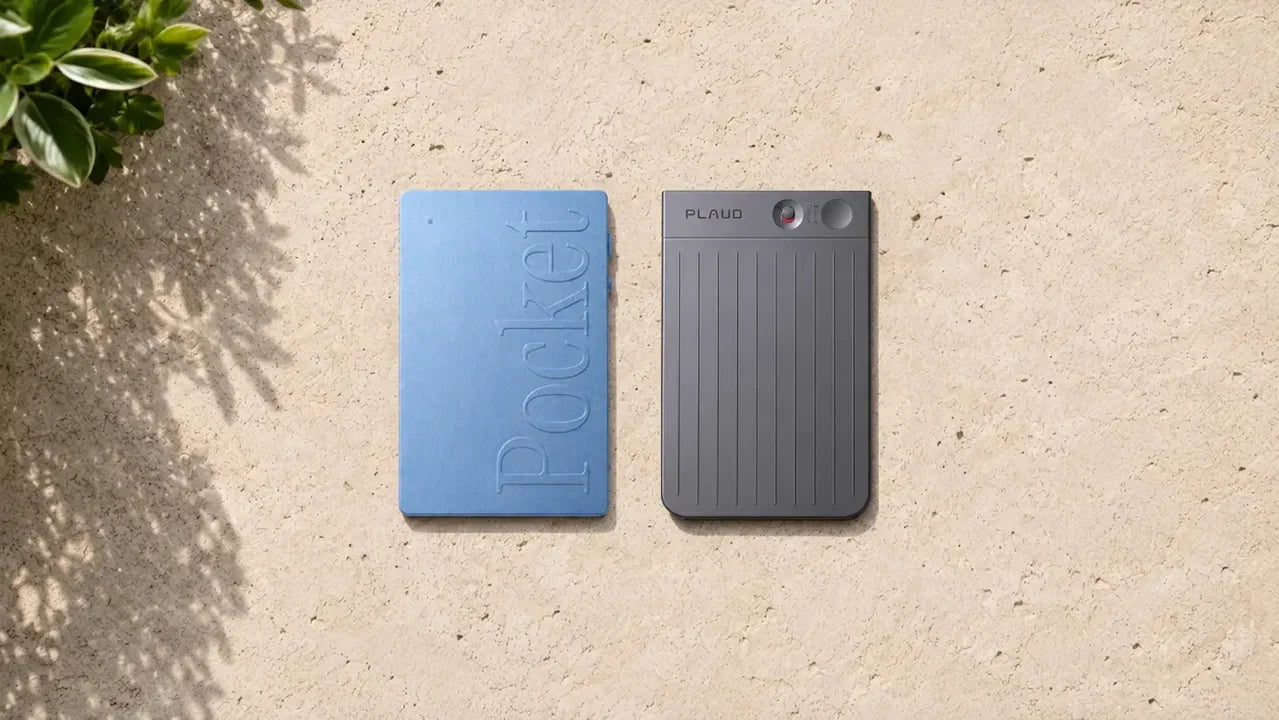
Plaud vs Pocket comes down to polish against price. Plaud is the more finished product: a mature app, better playback and search, and a real review record behind it. Pocket costs less, lets you choose which AI model writes your notes, and has a free tier that is genuinely usable. Both are press-to-record. Legend, the third column below, is the one that is not, and that difference costs a lot more than either of them.
| Plaud | Legend | ||
|---|---|---|---|
| Price | $159 Note, $179 NotePin S | $129, down from $199 | $499 USD, first year included |
| Subscription | Free 300 min/mo, Pro $8.33/mo | Free tier, or Pro $199/yr | $499/yr |
| Three year total | About $479 on Pro | $129 free, $726 on Pro | $1,497 |
| Capture | Press to record | Press to record | Always on |
| Audio storage | Stores recordings | 64GB on device, plus cloud | None, transcribed instantly |
| Battery | Varies by model | Up to 4 days | About 2 days |
| Works offline | Yes | Yes, syncs later | Yes. Transcribes on the device and syncs the text when you are back in Bluetooth range |
| Choose your AI model | No | Yes | No |
| Best for | Meetings you scheduled | Cheapest capable capture | Conversations you did not see coming |
Plaud vs Pocket: The Short Answer
Buy Plaud if this is your first AI recorder and you want reliable meeting notes without configuring anything. It is the lower-risk purchase and the app quality shows.
Buy Pocket if you already know which AI model you like, if you want your notes flowing into other tools, or if price is decisive. At $129 it undercuts the Note by thirty dollars and the free tier means you may never pay again.
For most first-time buyers, Plaud. For anyone with an existing workflow to plug into, Pocket.
What Is Pocket Better At?
Three things, and they matter more than they sound.
Model choice. Pocket lets you point your captures at the AI model you prefer rather than accepting whatever the manufacturer picked. This genuinely changes the output. Summarisation style, how aggressively action items get extracted, how well it handles jargon, all of it shifts with the model. If you have opinions about which model writes the notes you actually want, no other recorder in this bracket gives you that.
Data portability. The MCP server is the underrated feature. Your recordings can flow into other tools rather than living trapped in one company's app. That sounds like a power-user concern until you consider what happens when you want to leave, or when the company gets acquired, which happens constantly in this category.
The free tier is real. Unlimited transcription at standard accuracy, mind maps, plain text export, and summaries kept for 30 days without paying anything beyond the hardware. Plaud's free Starter tier caps you at 300 minutes a month. If your volume is high and your budget is zero, that gap decides it.
Pocket also runs up to four days on a charge and reviewers give it longer microphone range, which helps in a conference room rather than across a desk.
What Is Plaud Better At?
Being finished.
The app is more mature, playback and search work better, and there is a real review history behind it. The NotePin took Tom's Guide's Best Wearable AI award in 2025. When you buy Plaud you are buying something a lot of people have already stress-tested, which is worth something in a category where half the products are one funding round from disappearing.
Plaud also gives you a choice of shape. The Note is a card that magnets to the back of your phone, which suits people who would rather not wear anything. The NotePin is a wearable pin for all-day use. Pocket offers a clip or a MagSafe mount, which covers similar ground, but Plaud's two distinct products are more clearly designed for their respective jobs.
The cost of that polish is the closed pipeline. You get Plaud's summarisation, not your choice of it, and pulling your data out is harder.
What Do They Actually Cost Over Three Years?
Upfront price is the wrong number in this category. On Plaud's Pro tier you are at roughly $479 across three years. On Pocket's Pro tier, $726, which makes the cheaper device the more expensive one if you pay for the top plan. On Pocket's free tier you never leave $129.
That inversion is the single most useful thing to understand before buying either. We ran the same calculation for every device in the category in AI Pendant Subscription Costs.
Which Should You Buy?
Buy Plaud if you want the finished experience, if you would rather magnet a device to your phone than wear one, or if search and playback matter because you go back to old recordings.
Buy Pocket if price is the constraint, if you want model choice and data portability, or if you record in larger rooms.
If you want the wider field, we ranked everything in Best AI Wearables 2026 and covered neck-worn devices specifically in Best AI Pendant 2026.
What Both of Them Miss
Worth naming, because it decides whether either device is right for you at all.
Plaud and Pocket are both press-to-record. There is a session, a purpose, and a set of notes at the end. That design is correct for meetings, interviews and calls, and both do that job well. But it assumes something: that in the moment a conversation becomes important, you will notice, remember the device exists, and press it.
Everything you deliberately record is something you already identified as worth recording. That excludes the corridor exchange, the number mentioned on the way out of an appointment, the plan made in passing. Those are the moments that cost you later, and by definition you cannot press a button for them, because you did not know they were coming.
The Takeaway
Between these two the choice is control versus polish, and it is genuinely close. Plaud for the finished experience, Pocket for flexibility and a lower price. Decide which of those you value and the rest follows.
The prior question is whether press-to-record is the right shape for your problem at all. If you can reliably predict which conversations will matter, it is, and one of these two is your answer. If the whole difficulty is that you cannot predict it, or that remembering to press something is the exact step your brain skips, that is a different category of device. Legend is a voice-first AI pendant made for people with ADHD that captures continuously without waiting to be triggered, transcribes in real time across more than 150 languages, and keeps no raw audio, so what remains is a set of notes rather than a library of recordings. A Halo light shows when it is active, and the day arrives as summaries and auto-generated to-dos in the Legend App. It costs a great deal more than either device here. We put it head to head with the cheaper option, price included, in Legend vs Pocket AI, and against Plaud's own wearable pin in Legend vs Plaud NotePin S.
FAQ
Plaud vs Pocket, which is better? Plaud for app polish, playback, search and track record. Pocket for model choice, data portability, a genuinely usable free tier, longer microphone range and a lower price. Plaud is the safer first purchase.
How much do Plaud and Pocket cost? Pocket is $129, down from $199, with a $99 launch special still advertised, plus a free tier and a Pro plan at $199 a year. Plaud starts around $159 for the Note, with the NotePin S at $179, a free Starter tier capped at 300 minutes a month and paid plans from $8.33 a month.
What is the difference between the Plaud Note and the NotePin? The Note is a card-shaped recorder that magnets to the back of your phone. The NotePin is a wearable pin designed for all-day use.
Do Plaud and Pocket record automatically? No. Both are press-to-record, so you start and stop each session yourself. Neither captures conversations you did not anticipate. Legend is the always-on alternative, at $499 including the first year of membership.
Sources: Pocket (heypocket.com) and Plaud product and pricing pages, checked August 2026. Prices in this category change often, so confirm at source before buying.
Share:
The Second Brain You Don't Have to Build
The Memory Pendant That Never Records You