


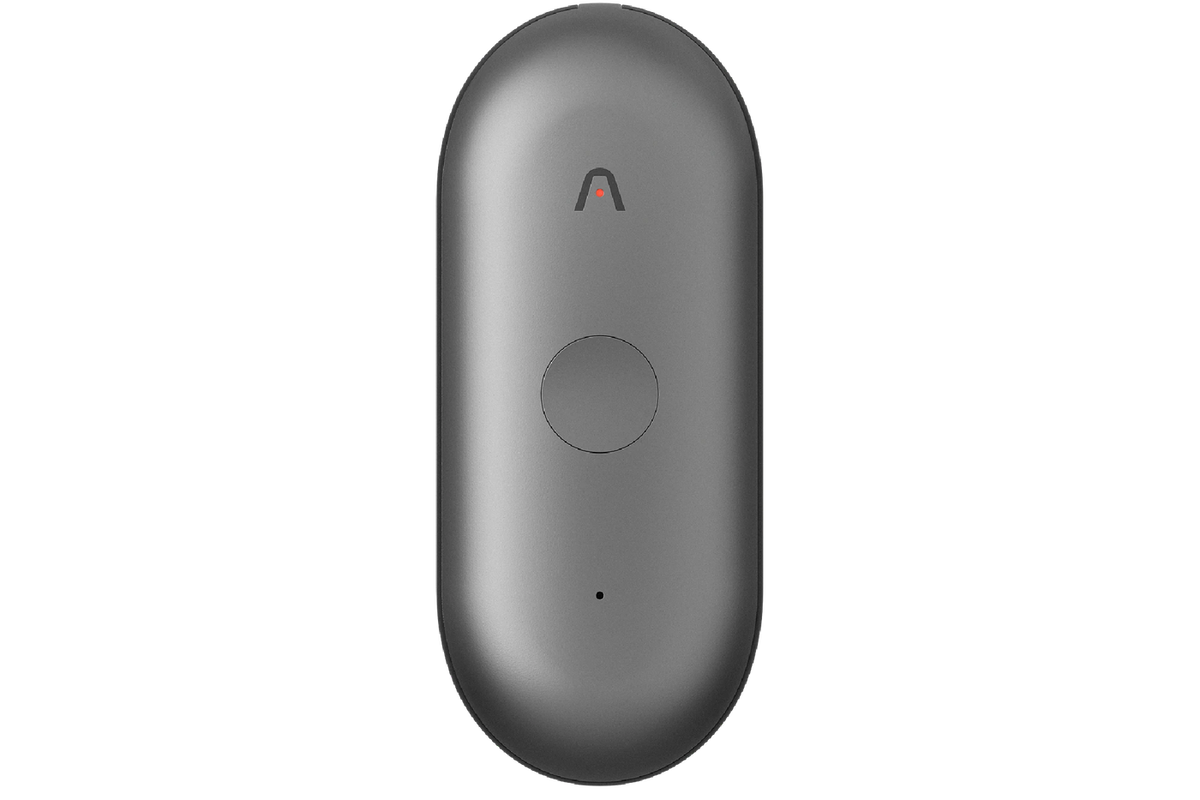
soundcore Work vs Plaud NotePin S is the closest fight in worn AI recorders right now, because Anker has brought a major consumer brand into a category Plaud has quietly owned. Both are press-to-record, both keep an audio file, both can be worn as a pin or on a necklace, and they sit twenty dollars apart. The specs that decide it are not the ones on the front of the box. Here is what each maker actually publishes.
| Device | Price (USD) | Battery, device alone | Weight | Audio |
|---|---|---|---|---|
| soundcore Work | $159.00 | 8 hours non-stop recording, up to 32 with the case | 48g | Kept, AES-256 encrypted locally |
| Plaud NotePin S | $179.00 | 20 hours continuous, 40 days standby | 17g, published as 0.61 oz | Kept |
| Legend One | $499 USD, first year of membership included | 2 days continuous, 5 days standby | Worn at chest height | No audio file is ever created |
Which One Actually Lasts Longer?
On the device alone the Plaud NotePin S wins, and not narrowly. Twenty hours of continuous recording against eight is two and a half times the runtime, with forty days of standby on top.
Anker's answer is the charging case, which takes the total to thirty-two hours. The part most write-ups skip is that Anker says you can keep recording while the device sits in the case. So the case is not only a battery you retreat to, it is a way to extend a long session without stopping. Anker also publishes a fast charge of ten minutes for two hours of use, which is the more useful number on a normal day.
Read those claims carefully though. Thirty-two hours is a system figure that assumes you are carrying a second object. Eight hours is what the thing on your collar does by itself. If you leave the case at home, soundcore Work covers a working day and not much more. Plaud covers a working day twice over.
Makers quote battery in three incompatible ways across this whole category, and we untangled that in AI Pendant Battery Life Compared.
The Weight Difference Is Bigger Than It Looks
This is the specification that decides the purchase for most people, and it is buried in both spec sheets.
The NotePin S is 0.61 oz, about seventeen grams. soundcore Work is 48 grams. That is nearly three times heavier, and the gap is the difference between a device you forget about and one you keep adjusting. Seventeen grams on a lapel is roughly a large paperclip. Forty-eight grams pulls on a shirt, swings on a chain, and reminds you it is there.
If the plan is to wear it for an hour of meetings, it does not matter. If the plan is to wear it all day, it matters more than any feature either company advertises. Anker's own framing gives the game away: it lists three ways to use it and one of them is attaching it to your phone. That is a device designed to be carried at least as often as worn.
What Does Each One Do With Your Audio?
Both keep a file, so neither is the device to buy if your concern is that no recording of you should exist. What differs is where the file lives.
Anker is the more explicit of the two. Its published position is that "your audio and transcriptions are encrypted with AES-256 and stored locally on your device" by default, and that when you request a transcription "audio is processed temporarily in the cloud and permanently deleted immediately upon delivery". Local by default with a deletion promise on the temporary cloud copy is a clear and defensible design, and Anker deserves credit for stating it plainly. soundcore Work comes in 8GB and 64GB storage versions, so check which one you are buying.
Plaud describes capture, transcription and structured summaries through its app, and keeps the recording so you can go back to it. That is the normal arrangement for this class of device.
Keeping audio is a real feature rather than a flaw. Transcription is weakest on exactly the content you most wanted captured: names, addresses, dosages and numbers spoken fast. When the transcript garbles one, being able to replay it settles the question in seconds. We set out which devices across the category actually keep a file in AI Pendant That Doesn't Store Audio Recordings.
What Do They Cost Over Three Years?
This is where the twenty-dollar gap stops mattering.
soundcore Work has a free tier with 300 transcription minutes a month, Pro at $15.99 a month or $99.99 a year, and Unlimited at $239.99 a year. New users get six months of Pro at no charge, which is a genuinely aggressive offer. Plaud has Starter free with 300 minutes a month, Pro at $8.33 a month billed annually, and Unlimited at $19.99 a month billed annually.
Run those out. On the annual Pro tiers, soundcore Work costs $159 plus three years at $99.99, which is about $459. The NotePin S costs $179 plus three years at $99.96, which is about $479. Twenty dollars apart after three years, the same gap you started with. On the Unlimited tiers the order flips: soundcore lands near $879 and Plaud near $899.
So the subscription does not separate them. Pick on the hardware, because the running costs are effectively a tie.
Where Each One Genuinely Wins
Buy the Plaud NotePin S if you will wear it. Seventeen grams and twenty hours of continuous recording is the better all-day combination by a wide margin, and forty days of standby means it survives being ignored for a month. Plaud has also been in this category longer, and its app and summary quality are the reason it became the default.
Buy soundcore Work if you will carry it. It is twenty dollars cheaper, the six-month Pro trial is worth about fifty dollars on its own, the case lets you record past thirty-two hours without stopping, and ten minutes of charging buys two hours. Anker's support and returns operation is also larger than Plaud's, which is not nothing on a device you may need to replace. If your pattern is scheduled meetings where you take the device out, press it, and put it away, the weight penalty never lands on you.
Neither is a bad buy. This is a genuine coin-flip decided by whether the device lives on your body or in your bag.
Where an Always-On Pendant Fits Instead
Both of these share one limitation, and it is structural rather than a flaw in either product. They only capture what you decided to capture. Press the button and you get a recording. Forget, or fail to notice that the next ninety seconds mattered, and there is nothing.
For scheduled conversations that is fine, and it is why a $159 or $179 recorder is the right answer for most working people. We compared the other two leading press-to-record devices in Plaud vs Pocket AI.
Legend One solves the other half. It is a voice-first AI memory pendant made for people with ADHD, worn at chest height with three microphones and speaker separation, always on with no button. It transcribes speech to text instantly across more than 150 languages, and no audio file is written at any point. Transcription happens on the device and the text is stored locally, then syncs to your phone when you are back in Bluetooth range. A Halo light shows when it is active. Two days of continuous use, five days of standby, about a two-hour USB-C charge. It is $499 USD including the first year of membership, renewing at $499 a year, which is $1,497 over three years, with a 30-day money-back guarantee.
Two honest costs. It is roughly three times the price of either recorder here, and if your conversations are scheduled you are paying for coverage you will not use. And because no audio file exists there is no playback, so a garbled name cannot be checked by listening again. Both devices on this page can do that.
The Takeaway
Weight and the case are the whole decision, and the subscriptions cancel out.
Buy the Plaud NotePin S at $179 if it is going on your body every day. Seventeen grams and twenty hours device-alone is the better wearable, full stop. Buy soundcore Work at $159 if it lives in a bag between meetings, if you want the six-month Pro trial, or if you value Anker's support network. Buy Legend at $499 USD only if the conversations that cost you are the ones you did not plan for and pressing a button is the step that fails. Buy neither of these if you want a device that keeps no recording, because both keep an audio file by design.
FAQ
Is soundcore Work better than the Plaud NotePin S? Not on the specs that matter for wearing it. The NotePin S is 0.61 oz against 48 grams and runs 20 hours on the device against 8, which makes it the better all-day recorder. soundcore Work is twenty dollars cheaper, includes a charging case you can record from, and comes with six months of Pro.
How long does each one last on a charge? Anker publishes 8 hours of non-stop recording for soundcore Work, or up to 32 with the charging case, plus a 10-minute charge for 2 hours of use. Plaud publishes up to 20 hours of continuous recording and 40 days of standby for the NotePin S, with a 2-hour charge.
Which costs more over three years? Almost nothing separates them. On the annual Pro tiers soundcore Work is about $459 all in and the NotePin S about $479. On Unlimited the order reverses, at roughly $879 and $899. Decide on the hardware instead.
Do either of them keep your audio? Yes, both. Anker states audio is encrypted with AES-256 and stored locally by default, with temporary cloud copies deleted after transcription. Plaud keeps the recording so you can return to it. Neither is the device to buy if you want no recording to exist.
Sources: soundcore Work; Plaud NotePin S; Legend One. Prices, battery figures and audio claims are quoted from each maker's own product page, verified 10 September 2026. Prices are USD. Anker has recently discounted soundcore Work below its $159.00 list price on its collection listing, so check before paying full price.
Share:
Vibe Dot vs Bee: Is the $199 Device Worth Four Times the Price?