


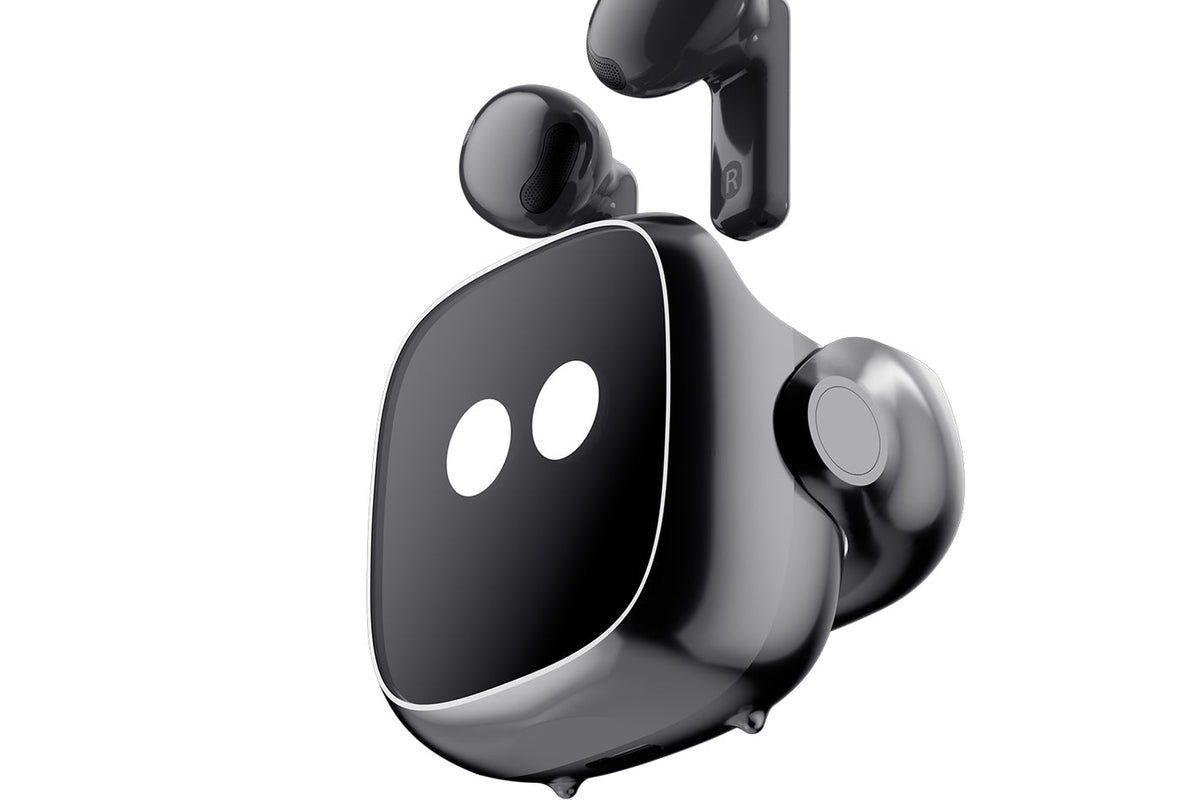
Two companies had the same idea at roughly the same time: put the recorder in the thing people already wear in their ears. OSO AI got there first and is selling. Plaud announced the more ambitious version and then sold out of it.
If you are choosing between them today, that is most of the answer. But the two devices are built around genuinely different bets, and the differences are worth understanding before the Plaud waitlist reopens.
One correction before we start, because it trips people up. Both of these are true wireless earbuds. Neither is a headphone, and neither is a pendant.
The short version
| OSO AI Earbuds | Plaud One Explorer Edition | |
|---|---|---|
| Price | $159.99, down from $249.00 | $249.99 USD |
| Can you buy it? | Yes. Add to Cart, in stock | No. Pre-order closed, waitlist only |
| Ship date | Shipping since August 2025 | Not published |
| Microphones | Dual beamforming, in the earbuds | 4 MEMS with beamforming in the case; 3 MEMS and 1 VPU per earbud |
| Recording time | 4 hours, up to 13 hours with the case | Up to 6 hours per bud; up to 25 hours continuous from the case |
| Listening time | 16 hours stereo, 32 hours mono | 4.5 hours with ANC on, 6 hours off |
| Cellular | No | Yes, 4G LTE with eSIM in the case |
| Free tier | 300 min per month, 30 days history | Starter, 300 minutes |
| Paid tier | Premium, $119 per year | Pro $17.99 per month, Unlimited $29.99 per month |
Availability is the real difference right now
Plaud lists the One Explorer Edition at $249.99 and shows it out of stock. The site reads: "The current pre-order has ended. Join the waitlist and be the first to know when pre-orders reopen." The only button is an email capture. There is no checkout and no deposit, and Plaud has not published a ship date. The Q4 2026 figure circulating in coverage is press reporting, not a Plaud statement. We covered the full picture in our Plaud One Explorer Edition explainer.
OSO is the opposite. The OSO AI Earbuds page has a working Add to Cart at $159.99, marked down from $249.00, with live inventory. The company shipped its first units in August 2025 after a Kickstarter that raised $81,421 from 422 backers, and the product is also carried by mainstream retailers. Whatever else you weigh, one of these is a purchase and the other is a mailing list.
Where the intelligence lives
This is the more interesting split, and it explains the price gap.
Plaud put the hard work in the case. The charging case carries four MEMS microphones with AI beamforming and its own 4G LTE connection over eSIM. It can record for up to 25 hours continuously and run 36 hours in total. The earbuds have three MEMS microphones and one VPU each and manage up to 6 hours of recording. Plaud is effectively selling two recorders that travel together: a long-haul one you set on the table, and a wearable one for when you need hands free.
OSO put everything in the buds. The earbuds carry a dual beamforming microphone array. The case is described as a "smart charging pod with built-in screen controls", so it has a display and it extends runtime, but OSO does not claim it records on its own. There is also an optional Power Stand that the FAQ says "adds 2 weeks of additional usage".
A note on OSO's battery numbers. The spec table gives "Recording Time: 4 Hours (13 Hours Max with Case)", while the FAQ describes "6 hours continuous use + 15 hours from the case = 21 hours total". Those are different figures for the same device, so the conservative reading is the spec table: four hours off a charge. OSO does not publish a weight or dimensions for the earbuds.
Where OSO clearly wins is ordinary listening. Sixteen hours of stereo playback against Plaud's 4.5 hours with ANC on is not close. If these are also going to be your everyday earbuds, that matters more than any transcription feature.
Do they really make to-do lists?
Close, and the distinction is worth getting right.
OSO's app is built by Laxis, a meeting-AI company, rather than by OSO itself. It records, transcribes in over 40 languages, summarises, and produces what both companies call action items: named tasks pulled out of the conversation and attached to whoever agreed to do them. A published example output reads "Alex to finalize the new launch date schedule". You also get 20+ report templates, an AI writer, and a chat assistant called Ask OSO. Phone calls can be recorded through the earbuds too.
What it does not do is silently drop those items into your task manager. They arrive inside a document. You can route them onward, because Laxis integrates natively with Slack, Notion, Jira, Monday, ClickUp, Confluence, Google Calendar, Outlook, HubSpot, Salesforce, Google Drive, Dropbox and the major meeting platforms, plus several thousand more through Zapier. But it is a step you set up, not a thing that happens by default.
Plaud's answer to the same problem is Plaud Agent, which connects to Gmail, Google Drive, Google Calendar, Slack and Notion, plus GitHub, Asana, Discord, Miro, Box and Figma, and supports any MCP-compatible service. The ambition is the same: end with a task in the tool you already use rather than a transcript you have to reread. Neither company has a meaningfully better story here, and neither has shipped the version of this that needs no configuration.
What happens to the audio
Both devices record audio files and both send them to a cloud service to be processed. That is the category they are in.
Plaud's published default is that "your recordings, transcriptions, and summaries are automatically deleted from our servers immediately after processing". Turn on Private Cloud Sync and they are kept until you delete them. It is a deliberate choice you make.
OSO's retention runs off your plan: the free Basic tier keeps "30 days conversation history", Premium gives "Unlimited conversation storage". The FAQ states "We do not collect user data. Instead, we provide secure storage for user data using Microsoft Azure Cloud." The App Store privacy label for the app lists User Content, specifically Audio Data, under data linked to you. Both of those are published by the companies involved, and if you plan to record anything sensitive it is worth reading both before you decide. Neither device does on-device transcription; transcription minutes are metered, which tells you the processing happens in the cloud.
What each one actually costs to run
OSO includes a Basic plan free with the hardware: 300 transcription minutes a month and 30 days of history. Premium is $119 per year on OSO's membership page, which raises you to 2,000 minutes a month, unlimited storage, live translation, the AI writer and an MCP connector. There is a second buying option on the product page that bundles a year of Premium for $278.00. Three years on Premium works out at roughly $517 all in.
Plaud ships the Explorer Edition with the free Starter plan and US$200 in Plaud credits. Beyond that, Pro is $17.99 a month or $8.33 a month billed annually, and Unlimited is $29.99 a month or $19.99 a month billed annually. Three years on annual Pro lands around $550 after the credits, and Unlimited closer to $970.
So the headline gap of $90 understates it slightly. OSO is the cheaper device and the cheaper subscription, and it is the one you can buy.
Which one suits which person
Buy OSO if you want recording earbuds today, you want them to also be your normal earbuds, and your meetings are the sit-down kind. The 16 hour playback figure and the $159.99 price make this the low-risk way into the category.
Wait for Plaud if your problem is the four-hour session. A case with its own cellular connection that records for 25 hours straight is not something OSO is trying to do, and for interviews, conferences and all-day fieldwork that is the whole ballgame. Just be clear that waiting is what you are doing.
If you want something buyable that is not earbuds at all, the SwitchBot AI MindClip is $119.99 and in stock.
Where Legend fits
Legend One is solving a narrower problem than either of these, and it is worth saying which problem, because it is not "better meeting notes".
Earbuds are excellent for the conversation you knew was coming. You sit down, you put them in, you record the hour. What they are poor at is the two minutes in a corridor when somebody tells you something that matters, because by the time you have earbuds in, the moment is over. Legend One is a $499 USD pendant you already have on, built for people with ADHD whose actual failure mode is the unplanned exchange that simply is not there an hour later.
It also handles audio differently from both devices here. Legend transcribes on the device as you speak and never writes an audio file at all, so there is no recording to retain for 30 days, sync to a workspace, or delete later. The text moves to your phone over Bluetooth once you are back in range, and there is no audio playback at any point. There is no subscription, either: $499 once.
OSO has built a well-priced, genuinely available pair of recording earbuds, and Plaud has designed something more ambitious that you cannot have yet. Legend is for the people whose memory problem happens away from the meeting table.
Frequently asked questions
Can you buy the Plaud One Explorer Edition right now?
No. Plaud's site says the pre-order has ended and offers a waitlist signup. There is no checkout, no deposit and no published ship date.
How much are the OSO AI Earbuds?
$159.99, reduced from $249.00, with a working checkout and stock available. A variant bundling one year of Premium is $278.00.
Are OSO AI Earbuds headphones?
No. They are true wireless in-ear earbuds with a charging case that has screen controls. The same is true of Plaud One.
Do OSO AI Earbuds create to-do lists?
They extract action items from a conversation into a summary document, including who agreed to do what. They do not write tasks directly into a to-do app by default, though the app integrates with Slack, Notion, Jira, ClickUp, Monday and others if you set that up.
Which has better battery life?
It depends what you are measuring. OSO publishes far longer playback, at 16 hours stereo against Plaud's 4.5 hours with ANC on. Plaud's case records far longer, at up to 25 hours continuous against OSO's stated 13 hours with the case.
Do either of them store my recordings?
Both record audio and process it in the cloud. Plaud says recordings are deleted from its servers immediately after processing unless you enable Private Cloud Sync. OSO keeps 30 days of history on the free tier and unlimited storage on Premium.
Verified 11 September 2026 on plaud.ai and oso8.com. OSO AI Earbuds are sold by OSO AI; the companion app is published by Laxis, Inc. Product photo: OSO AI.
Share:
What Is the SwitchBot AI MindClip? The $119.99 Clip-On Recorder, Explained
Vibe Dot vs Bee: Is the $199 Device Worth Four Times the Price?