


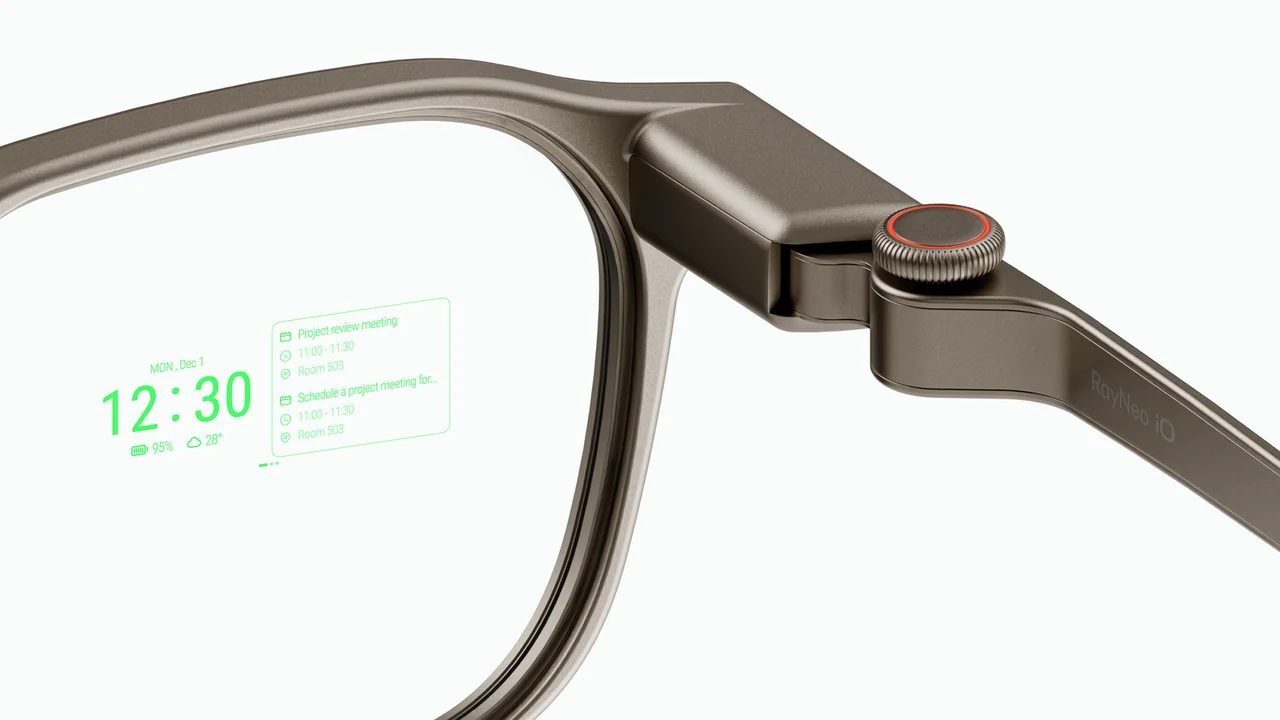
RayNeo announced the iO smart glasses on August 21, 2026, ahead of IFA in Berlin, and they arrive September 4 at $479. That puts them $320 below the Meta Ray-Ban Display at $799, and the two devices are far less alike than the price gap suggests. The iO has no camera and no speakers. The Ray-Ban Display has both, plus a full-color screen and a gesture-reading wristband. One is built to be invisible. The other is built to do everything.
RayNeo iO vs Meta Ray-Ban Display: The Short Answer
Buy the RayNeo iO if you want glasses you can wear all day that quietly handle translation, transcription, and reading text without announcing themselves to a room. Buy the Meta Ray-Ban Display if you want a camera, color visuals, audio in your ears, and the Neural Band gesture control, and you accept the weight and the six-hour battery that come with it.
Specs Compared
| Spec | RayNeo iO | Meta Ray-Ban Display |
|---|---|---|
| Price | $479 | $799 |
| Released | September 4, 2026 | September 30, 2025 |
| Weight | 33g | Roughly double the iO |
| Display | Monochrome green, 23.5° FOV, 1,300 nits | Full color 600x600, 20° FOV, up to 5,000 nits |
| Camera | None | 12MP, 1080p video |
| Speakers | None | Dual off-ear speakers |
| Microphones | 4, plus bone conduction sensor | 5 |
| Battery | Up to 2 days typical, 18 hours recording | Up to 6 hours mixed use, 30 hours with case |
| Control | Smart Crown dial, head gestures | Neural Band sEMG wristband |
| Translation | 55 languages, 109 accents | Live translation, fewer languages |
| Water resistance | IP54 | Not rated on glasses, IPX7 on band |
Why Did RayNeo Leave Out the Camera?
This is the most interesting decision in the product, and it is not an accident or a cost cut. RayNeo built the iO as a visual-first device: information goes to your eye, and nothing goes the other way. There is no lens pointed at the person across from you.
Anyone who watched Google Glass fail in 2013 understands why that matters. The objection was never the computing. It was the camera, and the fact that nobody around you could tell what it was doing. Meta solved that problem partially with a capture LED. RayNeo solved it by removing the hardware.
The consequence is that the iO cannot take a photo, cannot record video, and cannot do any of the multimodal tricks that depend on the glasses seeing what you see. If you want to point at a menu and ask what a dish is, the iO is the wrong purchase. If you want to sit through a client dinner without anyone wondering whether they are being filmed, it is the right one.
Why Are There No Speakers?
The second omission is stranger, and it is the one most reviewers flagged. The iO has zero speakers. Every notification, every translation, every AI response arrives as text on the display and nowhere else.
RayNeo spent that space on input instead. There is a four-microphone array plus a bone conduction sensor that isolates your own vocal vibrations from the room, which is the kind of hardware you add when transcription accuracy is the actual goal. The frame is magnesium-aluminum alloy with titanium temples, 50:50 front-to-rear weight distribution, and the whole thing comes in at 33 grams. That is light enough to forget you are wearing it, which is the entire pitch.
The tradeoff is real. You cannot listen to music, take a call through them, or hear an AI answer read aloud. On the Ray-Ban Display, dual off-ear speakers make it a genuine audio device. On the iO, silence is a design position.
What Can the RayNeo iO Actually Do?
Three things, and it does them without your hands.
Translation. Timekettle's BabelOS 3.0 handles 55 languages and 109 accents with roughly one second of latency, rendered as text in your field of view. For travel and cross-language meetings this is the strongest single use case on the device, and the accent coverage is unusual. Most translation features handle standard dialects and fall apart on everything else.
Ambient capture. RayNeo calls it the Ambient AI Life Log. The glasses listen to conversations, extract action items, and push calendar suggestions. This is the same job an AI pendant does, moved to your face.
Teleprompter. An auto-scrolling script in your eyeline, controlled with the Smart Crown rotary dial on the temple. Niche, but for anyone who presents regularly it is worth the price on its own.
Underneath it runs RayNeo AI with Gemini 3.1 Flash Lite, and a $9.99 monthly upgrade opens access to other models including ChatGPT, Claude, and DeepSeek. Model choice as a subscription tier is a new idea in wearables and worth watching.
What Does the Meta Ray-Ban Display Do Better?
Quite a lot, and the $320 premium is not arbitrary.
The display is full color at 600x600 and up to 5,000 nits, which means it works in direct sunlight where a monochrome green overlay struggles. The 12MP camera shoots 1080p video. The Neural Band reads muscle signals at your wrist so you can control the interface with small finger movements, which remains the most impressive input method anyone has shipped in this category. And Meta has distribution, retail presence, and a two-generation head start on the software.
The costs are battery and bulk. Six hours of mixed use means the charging case is part of your day, not a backup. And the glasses are noticeably heavier than a 33-gram frame, which you feel by hour eight.
Which Smart Glasses Should You Buy?
Split it by what you want the glasses to be.
Buy the RayNeo iO at $479 if you want a pair of glasses first and a computer second. All-day battery, no camera to explain, no speakers to leak, and a translation engine that is better than it has any right to be at this price. It is the choice for people who travel, take a lot of meetings, or simply do not want a gadget on their face.
Buy the Meta Ray-Ban Display at $799 if you want the fullest version of what smart glasses can currently do. Camera, color, audio, gesture control, and a platform that will keep getting updates. It is more device, and it asks more of you in weight and charging.
RayNeo has earned the benefit of the doubt here, holding 23.7% of global consumer AR smart glasses shipments in Q1 2026 by Counterpoint's count, ahead of every other maker in the category. The iO is not a first attempt.
The Takeaway
The most revealing thing about the iO is not the price. It is that a company competing with Meta chose to ship fewer sensors on purpose, betting that discretion sells better than capability. The Ambient AI Life Log tells you where the real competition is heading: not toward glasses that see more, but toward wearables that quietly keep track of what was said so you do not have to.
That is the problem Legend was built around, in a form that does not sit on your face. Legend is a voice-first AI pendant made for people with ADHD, worn at chest height where speech carries most reliably from both sides of a conversation. It transcribes in real time across more than 150 languages, keeps no raw audio, and shows a Halo light whenever it is active so the people around you can see it working. The day arrives as summaries and auto-generated to-dos in the Legend App on iOS and Android, with about two days of use from a two-hour charge. Glasses give you a screen. Legend is focused on the narrower job of making sure nothing said to you gets lost.
FAQ
How much do the RayNeo iO smart glasses cost? $479, launching September 4, 2026, in Polar Night and Dune colorways. An optional $9.99 monthly plan adds access to additional AI models including ChatGPT, Claude, and DeepSeek.
Do the RayNeo iO glasses have a camera? No. RayNeo left the camera out deliberately to address the privacy objection that has followed camera-equipped smart glasses since Google Glass.
RayNeo iO vs Meta Ray-Ban Display, which is better? The iO is lighter at 33 grams, lasts up to two days, and costs $479. The Ray-Ban Display costs $799 and adds a full-color screen, a 12MP camera, speakers, and Neural Band gesture control, but runs about six hours per charge.
How many languages does the RayNeo iO translate? 55 languages and 109 accents through Timekettle BabelOS 3.0, with roughly one second of latency, displayed as text in your field of view.
When do the RayNeo GT and GT Max launch? Also September 4, 2026, with pricing announced that day. The GT offers a 231-inch virtual screen at 46 degrees, the GT Max a 307-inch screen at 59 degrees, both with Bang and Olufsen quad speakers.
Sources: Engadget: RayNeo is going both minimalist and maximalist with its latest AR smart glasses; PR Newswire: RayNeo Expands Consumer AR Lineup; Android Headlines: RayNeo Just Announced Three New Smart Glasses Ahead of IFA; Road to VR: Meta Unveils Ray-Ban Smart Glasses with Display. Image credit: RayNeo via Engadget.
Share:
Plaud NotePin S vs Bee: Which AI Wearable Should You Buy?
Garmin CIRQA Ring vs Oura Ring: Should You Wait for Garmin's Smart Ring?