


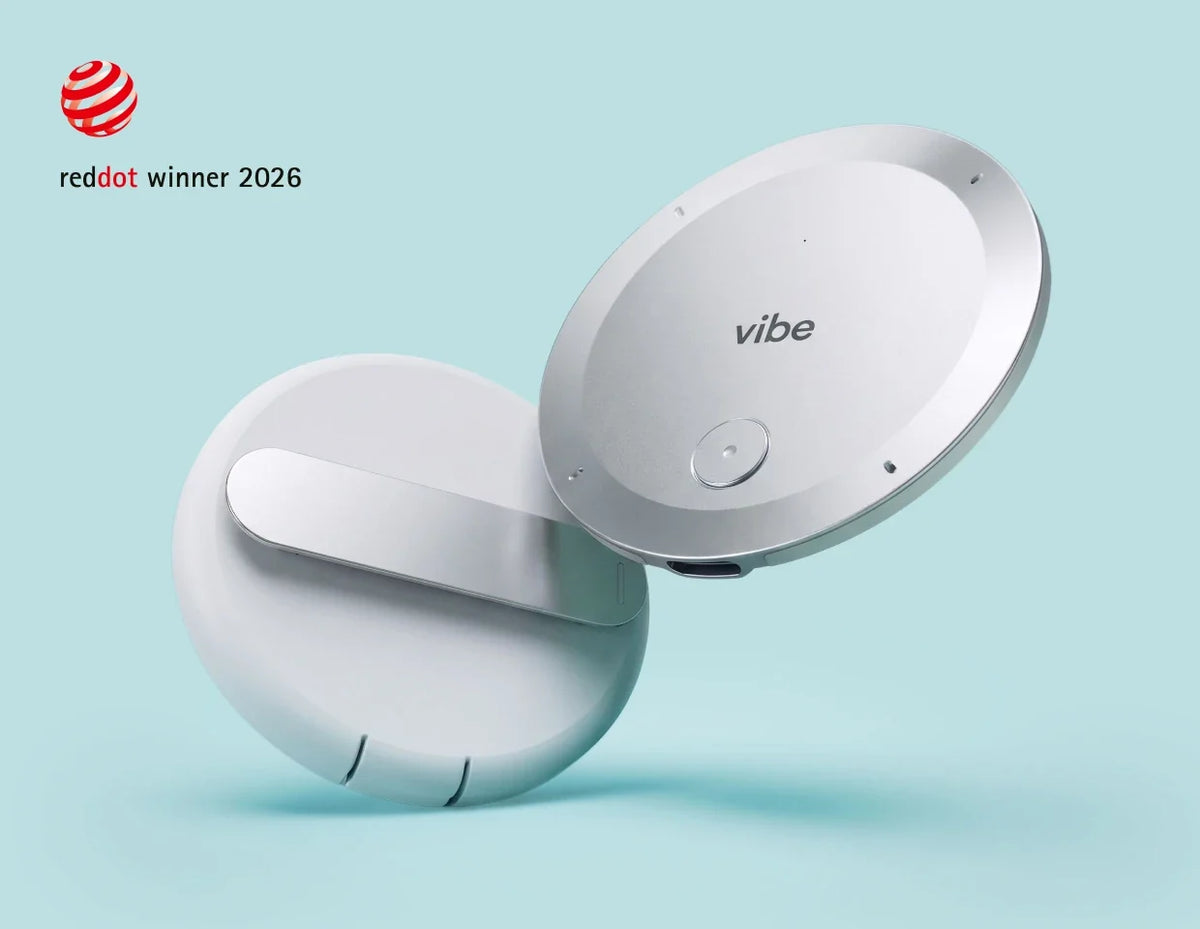
Vibe Dot vs Bee is the widest price gap in the category. Vibe Dot is $199, down from $249. The Bee Pioneer Edition is $49.99. That is four times the money, and the honest finding is that the cheaper device wins more of the axes that matter, including two you would expect the expensive one to take. Here is what each maker publishes, and where the extra $150 actually goes.
| Device | Price (USD) | Battery | Capture | Audio |
|---|---|---|---|---|
| Bee Pioneer Edition | $49.99 | 7 days, stated as 160+ hours | Button press, stops after 15 minutes of silence | Bee publishes that none is kept |
| Vibe Dot | $199, down from $249 | 30+ hours | Tap, press and hold, or an auto mode still in Beta | Kept, 64GB local, synced to the phone and then the cloud |
| Legend One | $499 USD, first year of membership included | 2 days continuous, 5 days standby | Always on, no button | No audio file is ever created |
Battery Is Not Close
Bee publishes seven days, or 160 hours plus, on a single charge. Vibe publishes 30 plus hours. That is more than five times the endurance for a quarter of the price, and it is the single most lopsided comparison on this page.
Both numbers are continuous-use claims rather than standby figures, so for once they are directly comparable, which is rare in this category. We untangled how differently makers quote this in AI Pendant Battery Life Compared.
Bee also auto-stops after fifteen minutes of silence, which is a sensible power-saving behaviour and part of how it reaches a week. Vibe ships a charging case, which extends the practical runtime, but you are then carrying a second object to close a gap Bee does not have.
What Each One Does With Your Audio
This is the real philosophical split, and it runs the opposite way to the price.
Bee's published position, quoted exactly, is: "We never store audio recordings. All conversations are: Processed in real-time, Immediately deleted after processing, Never saved or stored." It also publishes "No AI model training with your data", "No selling or monetizing your data" and "No sharing with third parties". Two caveats belong next to that and neither is an accusation. The wording sits on a product page rather than in Bee's Privacy Notice. And structurally it is a deletion claim: a file is created, then removed.
Vibe is equally clear and goes the other way: "Vibe Dot stores your audio locally and syncs it to the Vibe AI App on your phone via Bluetooth. Your phone then handles the upload to the cloud for AI processing." So a recording exists, it lives on 64GB of onboard storage, and it reaches the cloud by way of your phone.
Neither approach is wrong. Keeping audio means you can replay a garbled name or a dosage, which is a genuine safety feature and the reason recorders are the right buy for scheduled conversations. Not keeping it means there is nothing to subpoena, leak or hand over. Pick the failure you would rather have. We set out where every device in the category sits in AI Pendant That Doesn't Store Audio Recordings.
Is Vibe's Auto Mode Actually Always-On?
Not yet, and this matters if automatic capture is why you are looking at it.
Vibe Dot's primary modes are manual. Press and hold for Spark, or double-tap to record. There is an automatic mode that "auto-records when it detects your voice", plus a scheduling option, but Vibe labels it Beta on its own product page. Beta is the company telling you the behaviour is not finished, and a buyer purchasing specifically for hands-off capture should treat it as a feature in progress rather than a shipped one.
Bee is honest in the other direction. It is a button press to start and stop. It does not pretend to be always-on.
So if hands-off capture is the requirement, neither of these reliably delivers it today at their published behaviour. That is worth knowing before spending $199 on the assumption that it does.
The Subscription Question Cuts Against Bee
Here is where Vibe takes a real point, and it is the most important thing in Bee's column.
Vibe publishes its plans: Starter free forever with 300 AI transcription minutes a month, Pro at $9 a month which Vibe states as $108 a year, and Max at $29 a month, stated as $348 a year. You can work out three years at the tier you want before you buy.
Bee publishes no subscription price at all. Its own page says "In the future, Bee will have a Premium monthly subscription" without naming a figure. So the $49.99 is the only number you have, and it is not the whole cost. Anyone telling you Bee's running cost is zero is guessing, and so is anyone quoting you a settled three-year total for it. Bee also charged $19 a month before Amazon acquired it in July 2025. That fee has been reported dropped, Amazon has confirmed nothing, and now Bee itself says a Premium tier is coming.
That is a genuine risk on the cheap option. A $49.99 device with an unknown annual fee can end up costing more than a $199 device with a free tier.
Where Vibe Dot Genuinely Wins
Four things, and they are real.
The audio file itself. If you want to replay what was said, Vibe can and Bee, by its own account, cannot. For anything involving numbers, names or instructions you may need to check, that is the deciding feature.
Published pricing. You can compute your own three-year cost. With Bee you cannot.
The microphone array. Vibe publishes a five-microphone system, four air microphones plus a bone-conduction microphone. Bone conduction picks up your own voice through contact rather than through the air, which helps in noise. Bee publishes no comparable detail.
It is small. 0.83 oz and 0.17 inches thin, so it disappears on a collar. Bee does not publish a weight.
Where an Always-On Pendant Fits
Both devices here need you to start them, which means both miss the conversation you did not see coming. For scheduled talk that is fine and $49.99 or $199 is the sensible spend.
Legend One is built for the other case. It is a voice-first AI memory pendant made for people with ADHD, worn at chest height with three microphones and speaker separation, always on with no button to press. It transcribes speech to text instantly across more than 150 languages, and no audio file is written at any point. Transcription happens on the device and the text is stored locally, then syncs to your phone when you are back in Bluetooth range. A Halo light shows when it is running. Two days of continuous use, five days of standby, about a two-hour USB-C charge. It is $499 USD including the first year of membership, renewing at $499 a year, which is $1,497 over three years, with a 30-day money-back guarantee.
Two costs, plainly. It is ten times the price of a Bee, and if your conversations are predictable you are paying for coverage you will not use. And because no audio file exists there is no playback, so Vibe can check a garbled figure and Legend cannot. We made the broader case against buying anything in this category in Are AI Pendants Worth It?, and compared the two best press-to-record recorders in Plaud vs Pocket AI.
The Takeaway
The cheap one wins more than it should, but it carries the bigger unknown.
Buy Bee at $49.99 if you want a week of battery, the strongest published no-storage claim in the category, and the lowest entry price, and you can accept that its subscription price is not published and a Premium tier is confirmed as coming. Buy Vibe Dot at $199 if you want the recording itself, a five-microphone array, and a subscription you can actually budget for, and you do not need the auto mode to be finished. Buy neither yet if hands-off capture is the whole reason you are shopping, because Bee uses a button and Vibe's automatic mode is still Beta. Buy Legend at $499 USD only if always-on is the requirement, you have ADHD, and no audio file existing is a feature rather than a loss.
FAQ
Is Vibe Dot worth four times the price of Bee? Only for specific reasons. Bee beats it on battery, five times over, and on price. Vibe earns the difference if you want the audio file to replay, a five-microphone array including bone conduction, and published subscription pricing you can budget against.
Which has better battery life, Vibe Dot or Bee? Bee, decisively. Bee publishes 7 days or 160 plus hours on a charge against Vibe's 30 plus hours. Both are continuous-use figures, so they are directly comparable, which is unusual in this category.
Does Bee record and keep audio? Bee publishes that it does not: conversations are processed in real time, immediately deleted after processing, and never saved or stored. That wording appears on its product page rather than in its Privacy Notice, so treat it as Bee's published claim. Vibe Dot does keep audio, on 64GB of onboard storage, synced to your phone and then the cloud.
Does Vibe Dot record automatically? Its main modes are manual, by tap or press and hold. An automatic mode that records when it detects your voice exists but Vibe labels it Beta on its own product page, so it should not be treated as a finished feature.
Sources: Bee Pioneer; Vibe Dot; Legend One. Prices, battery figures, capture modes and audio claims are quoted from each maker's own product page, verified 11 September 2026. Prices are USD and promotional prices move.
Share:
OSO AI Earbuds vs Plaud One Explorer Edition: Only One Is Actually On Sale
soundcore Work vs Plaud NotePin S: Which Worn Recorder Wins?