


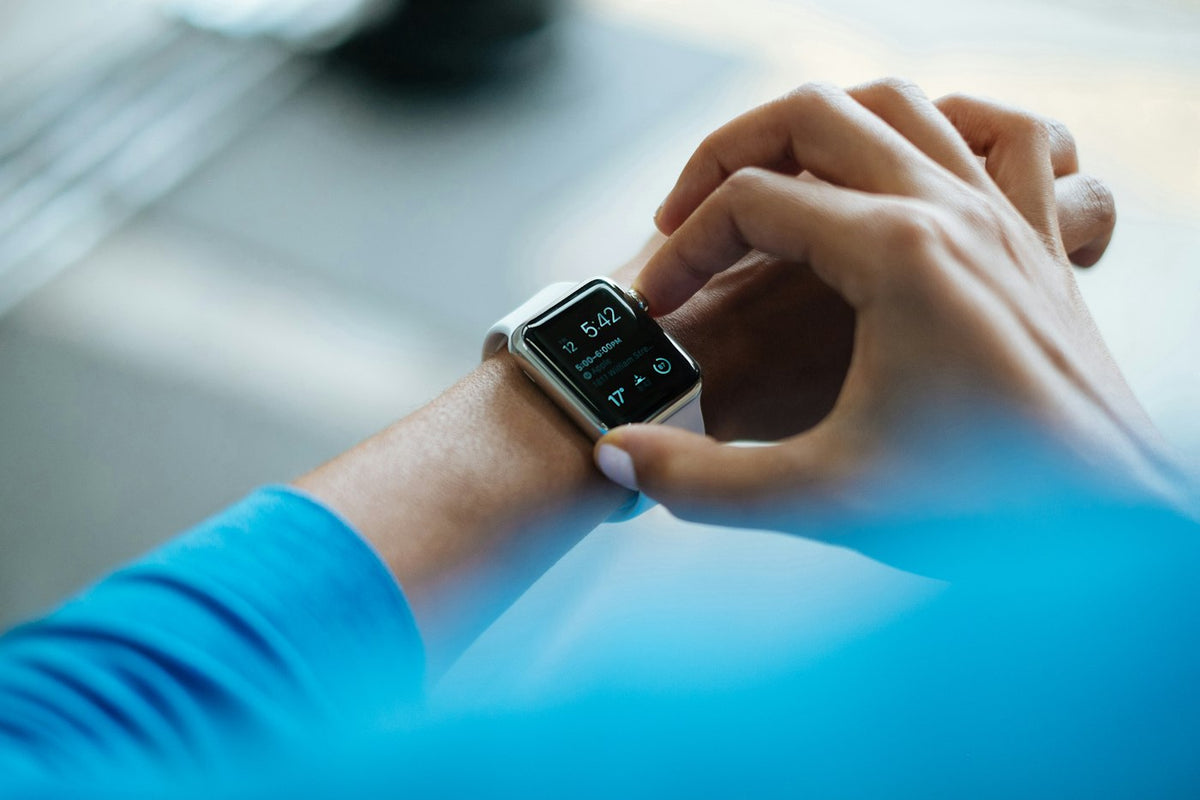
Siri Recap is Apple's answer to the question this whole category exists to solve: what was actually said today. Announced on 9 September 2026 alongside Apple Watch Series 12 and Ultra 4, it summarises your conversations through the day, and a companion feature called Live Rewind shows the last fifteen seconds of speech as text when you double-press the Digital Crown. If you were considering an AI memory pendant, you should read Apple's own support document before spending anything. Here is what it does, what it requires, and the one limitation that decides whether it replaces a dedicated device.
| Siri Recap on Apple Watch | Legend One | |
|---|---|---|
| What you get | Summaries of conversations through the day, plus a 15-second Live Rewind snippet | Transcripts, summaries and auto-generated to-dos |
| Audio | Apple: "Audio is not recorded or stored" | No audio file is ever created |
| Who said what | Apple: Siri Recap "will not identify and attribute speakers" | Three microphones with speaker separation |
| How long it keeps it | Auto-deletes after 7 days unless you save or export each one | Kept until you delete it |
| What you need to own | Apple Watch Series 12 or Ultra 4, plus iPhone 16 or later, plus Siri AI in beta | The pendant |
| Available now | No. Beta later this year, English first, not initially in the EU | Yes |
| Cost | Included with the hardware | $499 USD, first year of membership included |
What Apple Actually Announced
Apple calls it Audio Intelligence, and describes it as "a brand-new class of Apple Intelligence features that use the microphones of Apple Watch, the power of Apple silicon, and on-device and cloud-based AI models". There are four parts.
Sound Recognition detects sirens, alarms and doorbells. Music Recognition identifies songs nearby through Shazam. Live Rewind shows a text snippet of the last fifteen seconds of speech when you double-press the Digital Crown. Siri Recap creates summaries of conversations through the day.
TechCrunch described the last of those as "ambient listening to take high-level notes of your conversations", producing "a title, summary, and key points from the conversation" that you read in the Siri app, and noted that you can keep it always on, put it on a schedule, or turn it off entirely. It also pointed out that this is not a new idea, since notetakers like Granola and Circleback already do something similar and already have Apple Watch apps.
The first two are conveniences. The second two are the ones that matter here, because they are a mainstream consumer company putting ambient speech capture on a device tens of millions of people already wear. That is a bigger moment for this category than any pendant launch has been.
Apple Is Making Roughly the Same Privacy Claim We Do
This is worth stating plainly rather than dancing around, because Apple's document is public and anyone can check it.
Apple writes: "Audio is not recorded or stored. Audio Intelligence features don't create audio recordings." Raw audio enters what Apple describes as "a protected buffer inside the S11 chip's Secure Exclave" and is immediately deleted after processing. Siri Recap produces summaries rather than transcripts, and Apple says potentially harmful content is designed to be omitted.
That is architecturally close to what a transcribe-live design does, and Apple has the silicon to back it up in a way almost nobody else in this category can claim. If your reason for looking at a pendant was that you did not want a recording of your voice sitting on a server, Apple has just answered that for free, on hardware you may already be planning to buy.
We have been consistent that Legend is not the only device claiming not to keep audio, and this is the clearest example yet. We set out how the whole category compares on this axis in AI Pendant That Doesn't Store Audio Recordings.
The Seven-Day Problem
Here is the limitation that decides whether Siri Recap replaces a memory device, and it is in Apple's own document: "Siri Recaps auto-delete after 7 days if you don't save or export them." You can preserve one by saving it or exporting it to Notes or Journal.
Read that as a memory product rather than as a feature. A summary of Tuesday is gone the following Tuesday unless you took an action to keep it. Which means the system works only if you reliably notice, within a week, that a particular day contained something worth preserving, and then do something about it.
That is the same step that fails in every other capture system, and for people with ADHD it is the specific step that fails most. You do not usually know on Tuesday that Tuesday mattered. You find out three weeks later when someone asks what you agreed to. A memory tool with a seven-day window is closer to a very good short-term notepad than to a record you can search in a year.
None of that makes it a bad feature. It makes it a different product than it first appears, and the difference is the whole reason a dedicated device might still be worth money.
A Recap Will Not Say Who Spoke
This is a real functional difference, and it deserves to be stated accurately rather than used as a point to score.
Apple's wording, given to MacRumors, is that "Siri Recap will not identify and attribute speakers". A name can appear in a summary only if somebody says it out loud during the conversation. It is never derived from voice recognition. That is a deliberate privacy decision rather than a gap in the engineering. Telling voices apart by sound means analysing the voices of everyone near you, including people who never agreed to anything, and Apple has chosen not to build that.
It still costs you something, because of what the job actually is. Most people want a memory tool to answer one question: what did we agree, and who agreed to it. A summary saying the deadline moved to Thursday is much weaker than one saying the client's finance lead moved it to Thursday. In a two-person conversation you can usually reconstruct the attribution yourself. In a meeting with five people you often cannot, and a week later you certainly cannot.
Legend One takes the other side of that trade. It has three microphones with speaker separation, so the transcript distinguishes between voices. The cost is the thing Apple was avoiding: separating speakers means the device is processing the voices of the people around you, not only yours. That is the objection covered further down, and it is a fair one.
What Apple Strips Out of a Summary
Apple also filters the content of recaps. It says summaries exclude "language that promotes self-harm or hateful speech, financial data, government-assigned identifiers, authentication data, and certain personal identifiers".
For most people most of the time that is the right default, and it is good design. A summary you might leave open on a watch face is a bad place for a card number to be sitting.
It has an obvious flip side for a memory product. If the thing you needed to remember was an account number, a policy reference, a booking code or a case number that somebody read out to you on the phone, a filtered summary may not contain it. That is exactly the moment a memory tool is supposed to earn its money, and Siri Recap is designed to skip it.
The filter is not a guarantee in the other direction either. Apple concedes that it "may not remove all sensitive information", so a recap should not be treated as scrubbed clean. It cuts both ways. Some of what you wanted will be missing, and some of what you did not want may still be there.
What You Need to Own Before It Works
The hardware stack is steeper than the headlines suggest. Apple's support page requires an Apple Watch Series 12 or Apple Watch Ultra 4, and an iPhone 16 or later, and Apple Intelligence with Siri AI in beta.
So this is free only if you already own, or were already replacing, both halves. If you are on an older Watch and an iPhone 15, the entry cost to reach Siri Recap is considerably more than any pendant on the market. That is not a criticism of Apple, it is just the arithmetic a buyer should do before assuming the free option is free.
Sound Recognition and Music Recognition have a lower bar, working with an iPhone 11 or later on iOS 27. It is specifically the speech features that need the newest hardware on both wrists and pockets.
It Is Not Available Yet
Apple's own wording: "Live Rewind and Siri Recap will be available in beta later this year, starting with English." More languages are promised to follow, and Apple notes that "Siri AI will not initially be available in the EU on iOS, iPadOS, and watchOS".
There are also age limits. The features are not available to users under 13, and for under-18s on a Child Account a parent or guardian has to turn them on.
And Apple is refreshingly direct about quality: the summaries "may be incomplete or inaccurate. Important details may be omitted, misunderstood, or summarized incorrectly." Every AI summary carries that risk and most companies bury it. Apple put it in the support document.
The Bystander Objection, Which Lands on Us Too
The loudest reaction to the announcement had nothing to do with Apple's engineering. It was about everybody else in the room.
The MacRumors forum thread ran to hundreds of comments and the dominant objection was consent. Siri Recap is opt-in for the person wearing the watch and not for the person standing next to them, which one commenter reduced to "Not for the people around you it isn't." Others argued that a feature like this normalises "the behaviour of 24x7 recording everything everywhere", and expected military and corporate bans. Supporters in the same thread pushed back that it is off until you switch it on and that no audio is stored, so what exists afterwards is text rather than a recording of anyone's voice. Those are reader comments rather than expert analysis, but they map the argument fairly.
Writing at TechCrunch, Ivan Mehta put the middle position: "an always-listening feature will likely raise privacy concerns because Siri Recap may still capture sensitive information in its summaries." Apple's own answer is guidance rather than a rule. It tells wearers to "be mindful" of the people around them because "conversations might be private or sensitive", and stops short of asking anyone else for permission.
We are not going to pretend that objection lands on Apple and not on us. It applies to every always-on wearable, and that includes Legend One. A pendant hears the people you are talking to, and they did not buy it. Our answer is partial rather than complete: the Halo light shows when the device is active, so it is visible instead of hidden, and something people can see is something they can ask about and object to. That is a better position than a concealed recorder, and it is not consent. Nobody selling a device in this category has solved that, including us. We wrote about the social side of it at length in Is It Creepy to Wear an AI Pendant?
Where Apple Wins, and You Should Not Buy a Pendant
This section matters more than the rest, so here it is without hedging.
If you already own or are buying a Series 12 or Ultra 4 and an iPhone 16 or later, wait and try Siri Recap first. It costs you nothing extra. It arrives on a device you are already wearing, with no second thing to charge, no second thing to remember, and no second thing to explain to people. Apple's on-device privacy engineering is better resourced than anyone else's in this space. And a seven-day window genuinely is enough for a large number of people, because most of what you need to remember, you need to remember this week.
For that buyer, spending hundreds of dollars on a dedicated device to duplicate a free feature would be a poor decision, and we would rather say so than sell you something you do not need. If you are not sure the category is for you at all, we made the general case against it in Are AI Pendants Worth It?
Where a Dedicated Device Still Earns Its Place
Four situations, and they are narrower than they were a week ago.
You need it to persist. If the point is a searchable record you can return to in six months, a seven-day auto-delete is disqualifying unless you will reliably save each day, which is the assumption most capture systems break on.
You are not in the Apple stack, or not in that part of it. Android users, EU users at launch, and anyone on older hardware are not getting this.
You want the transcript, not a summary. Siri Recap produces summaries. A summary is a model's judgement about what mattered. A transcript lets you check. It is also where speaker separation shows up, since a recap will not tell you who said which part.
Microphone position. A wrist sits below the table, points away from whoever is talking, and moves constantly. A device at chest height faces the person speaking. For catching the other side of a conversation rather than your own voice, that is a real difference in physics rather than software.
Legend One is built for those cases. It is a voice-first AI memory pendant made for people with ADHD, worn at chest height with three microphones and speaker separation, always on with no button. It transcribes speech to text instantly across more than 150 languages, and no audio file is written at any point. Transcription happens on the device and the text is stored locally, then syncs to your phone when you are back in Bluetooth range, so it works on iOS and Android. A Halo light shows when it is active. Two days of continuous use, five days of standby. It is $499 USD including the first year of membership, renewing at $499 a year, which is $1,497 over three years, with a 30-day money-back guarantee.
The honest cost, unchanged by anything Apple announced: because no audio file exists there is no playback. If a transcript garbles a name you cannot listen again. Devices that keep audio can, and we compared the two best of those in Plaud vs Pocket AI.
The Takeaway
Apple has validated the category and taken a real bite out of it, and pretending otherwise would insult anyone who can read a support page.
Wait for Siri Recap if you are already in the Series 12 plus iPhone 16 world and a week of memory covers what you need. It is free and it will be good. Do not buy anything yet if you are planning that upgrade anyway, because the feature ships in beta later this year and you can try it first. Look at a dedicated device if you need the record to survive longer than seven days, if you are on Android, if you are in the EU, if it matters that the record says who said what, or if catching what other people said matters more than catching your own voice. Remember the disclaimer whatever you buy, because Apple is right that these summaries can omit or misunderstand important details, and that applies to every product in this category including ours.
FAQ
What is Siri Recap? An Apple Intelligence feature that creates summaries of your conversations through the day using the microphones on Apple Watch Series 12 or Ultra 4. It ships in beta later in 2026, starting in English, and requires an iPhone 16 or later alongside the watch.
Does Siri Recap record your conversations? Apple states that it does not: "Audio is not recorded or stored. Audio Intelligence features don't create audio recordings." Raw audio passes through a protected buffer inside the S11 chip and is deleted immediately after processing, with summaries produced rather than recordings.
Does Siri Recap know who said what? No. Apple's wording is that "Siri Recap will not identify and attribute speakers", and a name can appear in a summary only if someone says it out loud during the conversation. It is a deliberate privacy choice, but it means a recap tells you what was said rather than who said it. Legend One has three microphones with speaker separation, so its transcripts distinguish between voices.
How long does Siri Recap keep summaries? Seven days. Apple's support document says recaps "auto-delete after 7 days if you don't save or export them". You can keep one by saving or exporting it to an app such as Notes or Journal.
Do you still need an AI pendant if you have Siri Recap? Often not. If you own the required hardware and a week of memory is enough, it covers the same job at no extra cost. A dedicated device is worth considering if you need a record that persists beyond seven days, you are on Android, you are in the EU at launch, you need the record to attribute who said what, or you need to capture what other people said rather than mostly your own voice.
Sources: Apple Support, About Audio Intelligence features on Apple Watch Series 12 and Apple Watch Ultra 4; Apple Newsroom, Apple Watch Series 12; MacRumors, Apple Explains What Happens to Conversations Siri Recap Hears, 10 September 2026; TechCrunch, Ivan Mehta, Apple Watch's new feature listens to your chats and recaps them, 9 September 2026; Legend One. Apple quotations are taken from Apple's own support document and from Apple's statements reported by MacRumors, verified 11 September 2026. Quoted forum comments are reader posts on the MacRumors discussion thread, not expert opinion. Prices are USD. Availability, languages and regional support are Apple's stated plans and may change.
Share:
ADHD Tool That Turns Conversations Into To-Dos: What Actually Works
What Is Siri Recap? Apple's Audio Intelligence Features Explained