


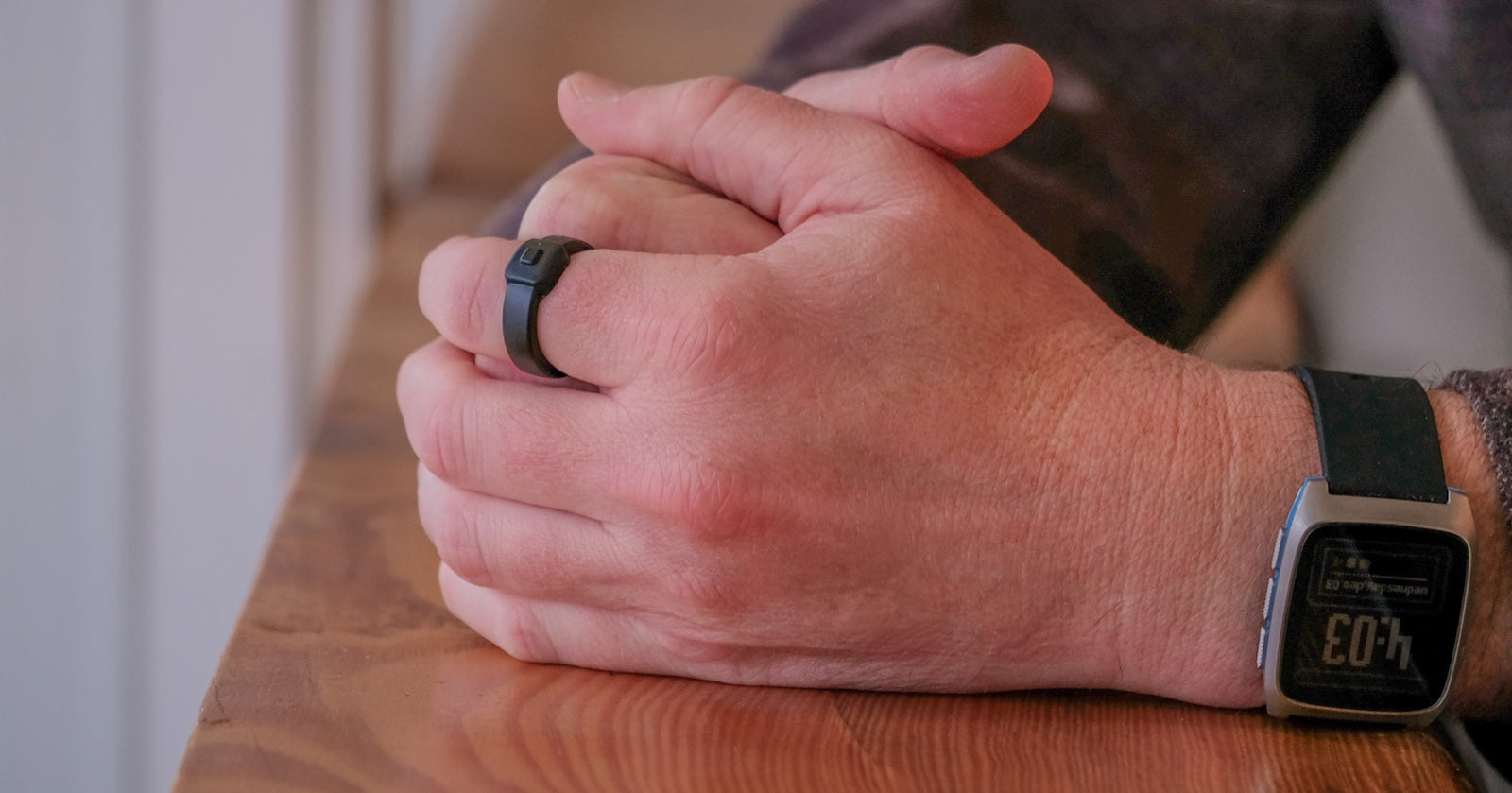
The Pebble Index 01 is a $75 voice-capture smart ring from Core Devices that records only while you hold its button down, transcribes on your phone rather than in the cloud, and never needs charging because it runs on a non-rechargeable silver-oxide battery good for roughly two years. It has no screen, no sensors, no health tracking and no subscription. Pre-orders are $75 and the price rises to $99 at full retail.
| Pebble Index 01 | Bee | Legend | |
|---|---|---|---|
| Price | $75 pre-order, $99 retail | $49.99, published by Bee | $499 USD, first year included |
| Subscription | None | Formerly $19/mo, current status not published | $499/yr |
| Capture | Press and hold, 5 min max | Always on | Always on |
| Worn as | Ring | Wristband or clip | Pendant, chest height |
| Processing | Local, on your phone | Cloud | On device, transcribed live |
| Audio storage | On ring until sync, optional cloud backup | Not published | None, no audio file created |
| Battery | About 2 years, non-rechargeable | Rated 7 days | About 2 days, 2hr charge |
| Languages | 100+ | Up to 40 | 150+ |
| Best for | Catching a fleeting thought | Cheapest always-on capture | ADHD, conversations you did not plan |
That is the whole product. It is the narrowest AI wearable on the market, and the narrowness is the point.
What is the Pebble Index 01?
It is a stainless steel ring, about the size of a wedding band, with a button and a microphone inside. You press the button, whisper a thought, and it lands in your phone as a note, a reminder or a calendar entry. Core Devices, the five-person self-funded outfit run by Pebble founder Eric Migicovsky, announced it in December 2025 and pitches it as "external memory for your brain."
What it deliberately is not: an always-on listener. The Index 01 physically cannot record unless your thumb is on the button. There is no ambient capture mode, no meeting recording, no AI companion listening to your day. Most of this category is built on the opposite bet, that the device should hear everything and sort it out later. Pebble bet the other way, and priced accordingly.
How much does the Pebble Index 01 cost?
$75 as a pre-order, $99 at regular retail. Both figures come from Core Devices' own product page, and both are full purchase prices, not deposits. There is no monthly fee attached: the AI features run through the free Pebble app, and the company has committed to no subscription for them.
The one recurring cost is the ring itself. Because the battery is sealed and non-rechargeable, you eventually mail the ring back for recycling and buy a replacement. Core Devices estimates that happens roughly every two years for a typical user, which works out to something in the range of $40 to $50 a year of ownership. That is still well under what most always-on wearables charge in subscription fees, but it is not zero, and it is the number buyers most often miss.
How does it work?
Press and hold, speak, release. The ring writes the audio to a small onboard memory (about five minutes of capacity, which is also the per-recording ceiling) and holds it until your phone is in Bluetooth range. Once it syncs, the open-source Pebble app converts speech to text using a model running locally on the handset, then a second local model decides what the note should become: a task, a reminder, a plain note.
Nothing has to touch a server for the core loop to work. The app functions offline, and Core Devices offers cloud backup of recordings as an option rather than a requirement. For anyone who has read a privacy policy for an AI wearable and come away uneasy, that architecture is the actual selling point, more than the price is.
The developer story is unusually open for a consumer wearable. The app is open source, the ring supports webhook routing so you can send raw audio or finished transcripts to your own service, and Core Devices has built in Model Context Protocol support for custom actions. Button presses can also be repurposed to control music, a smart home device or a camera shutter. If you want to compare that philosophy against the closed, cloud-first designs that dominate the category, our guide to AI wearables ranked by the problem you are trying to solve lays out the tradeoff device by device.
What are the full specs?
| Spec | Pebble Index 01 |
|---|---|
| Price | $75 pre-order, $99 regular retail |
| Maker | Core Devices LLC (Eric Migicovsky) |
| Capture mode | Press and hold only, no always-on listening |
| Recording limit | Up to 5 minutes per press, about 5 minutes stored on ring |
| Transcription | On-device, runs locally on your phone, works offline |
| Languages | 100+ |
| Battery | Silver-oxide, non-rechargeable, roughly 12 to 15 hours total recording (about 2 years typical use) |
| Charging | None. Ring is mailed back for recycling and replaced |
| Dimensions | 2.95mm thick, 6.6mm wide |
| Weight | 4.7g (US size 10) |
| Materials | 316 stainless steel, liquid silicone rubber button |
| Water resistance | 1 meter (handwashing, dishes, showering; not swimming) |
| Finishes | Polished gold, matte black, brushed silver |
| Sizes | US 6 to 13 (size 6 in gold only) |
| Platforms | iOS and Android |
| Subscription | None |
| Open source | Yes, app source published; webhooks and MCP supported |
How does it compare to Bee, the cheap always-on wearable?
Bee is the natural rival because it is the only other capture wearable in the same price bracket, and because it answers the same question in the opposite way. Bee listens continuously and hands you a summary of your day. The Index 01 listens for four seconds when you tell it to.
One caution on Bee's numbers. Bee publishes $49.99 for its Pioneer Edition. It does not publish a subscription price. The $19 monthly fee it charged before Amazon acquired it in July 2025 has been reported as dropped, though Amazon has confirmed nothing and a Premium tier has been signalled without pricing. Treat Bee's running cost as unknown rather than zero.
The honest read: Bee is cheaper on the hardware and far better resourced, but it only works if you are comfortable with a device that hears everything, and its ongoing cost is not something you can currently plan around. The Index 01 is more expensive per unit and does far less, and for a certain kind of buyer that is exactly why it wins. Ring versus pendant versus clip is a real decision with real consequences for how often you actually use the thing, and we break the ergonomics down in the difference between AI pendants and AI rings.
Who is it for?
Three groups, clearly.
People who lose thoughts. If your problem is that an idea evaporates between the shower and the towel rack, the Index 01 is close to purpose-built. It is faster than unlocking a phone and there is no app to find.
Privacy hardliners. Local transcription, no mandatory cloud, an open-source app, and a device that is physically incapable of listening on its own. This is the only wearable in the category you can hand to a skeptical colleague and win the argument in one sentence.
Tinkerers. Webhooks, MCP, open source. If you want your notes going into your own pipeline rather than someone's SaaS dashboard, this is the only mainstream option that invites it.
Who it is not for: anyone who wants meetings captured. Five minutes per press and 12 to 15 hours of lifetime recording rule that out entirely. If meeting capture is the job, you want a dedicated recorder, and Plaud vs Pocket is the comparison to read instead.
What are the catches?
The battery is the big one. A sealed, non-rechargeable cell means the ring is a consumable with a two-year life. Core Devices defends the choice on the grounds that it is the only way to keep a ring this thin, this cheap and charger-free, which is technically true and still a recurring purchase.
Shipping has slipped. The original March 2026 date was missed after the first production verification test surfaced Bluetooth amplifier failures and a problem with the microphone's waterproof membrane. Core Devices targeted the first 2,000 units for mid-May and worked through the pre-order backlog over the following months. New orders currently quote one to two months.
And the five-minute ceiling is a real ceiling, not a soft one. This is a note-taker, not a recorder.
The Takeaway
Buy the Index 01 if you want to catch fleeting thoughts, you care about local processing, and you accept replacing the ring every couple of years. At $75 it is the cheapest credible way to get a capture device on your body, and the only one that runs entirely on your own hardware.
Buy Bee instead if your goal is a passive record of your day and you would rather not remember to press anything, and you can live with an ongoing cost the company has not published.
Buy neither if what you actually need is reliable capture of long conversations. Both of these are lightweight tools, and a two-hour meeting will defeat them.
FAQ
Does the Pebble Index 01 record all the time?
No. It only records while the button is physically held down, for a maximum of five minutes per press. It has no ambient or always-on mode.
Does the Pebble Index 01 need a subscription?
No. The AI features run through the free, open-source Pebble app with no monthly fee. The only ongoing cost is replacing the ring when the battery expires.
How long does the Pebble Index 01 battery last?
The silver-oxide battery supplies roughly 12 to 15 hours of total recording, which Core Devices estimates at about two years of typical use. It cannot be recharged or replaced, so the ring is mailed back for recycling and swapped for a new one.
Can you swim with the Pebble Index 01?
No. It is water-resistant to one meter, which covers handwashing, dishes, rain and showering. Core Devices does not recommend swimming.
All of which points at the split running through this whole category. The Index 01 answers "how do I not lose a thought" with a button. The other half of the market answers "how do I not lose my life" with continuous capture, and those buyers tend to want something worn at chest height rather than on a finger. Legend sits on that side: a voice-first AI pendant built for people with ADHD, worn at the collarbone, with three microphones, real-time transcription across 150+ languages, and a Halo light so everyone nearby can see when it is active. It transcribes instantly and no audio file is ever created at any point, encrypted at rest and in transit, running two days of continuous use on a two-hour USB-C charge. It is $499 including the first year of membership, with a 30-day money-back guarantee. Different problem, different object, same underlying wish: stop losing the things that mattered.
Sources: Core Devices: Pebble Index 01 product page; Pebble: Meet Pebble Index 01, External Memory For Your Brain; TechCrunch: Pebble's founder introduces a $75 AI smart ring; Gadgets and Wearables: Pebble Index 01 enters final testing; Wareable: The Pebble Index 01 is a $75 smart ring without a battery or sensors; Bee: Bee Pioneer Edition.
Share:
In 2026, the Real Luxury Isn't More Information. It's the Ability to Focus.
The Memory Device That Vanishes, So Your Memories Don't