

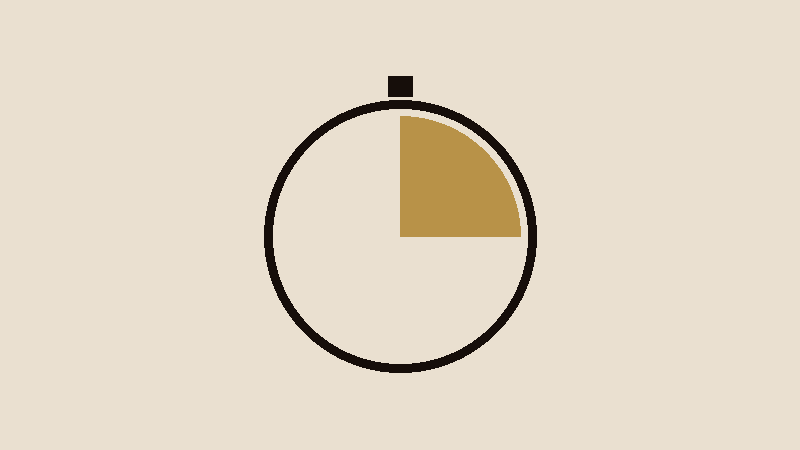
The Pomodoro Technique can work well for many people with ADHD, but usually only after some adjustment. Its core idea, working in a short, timed block followed by a break, helps with starting tasks and makes time visible. The classic 25-minute block is not sacred, though. Some people with ADHD need shorter blocks to get started, others need permission to keep going when they are finally focused, and almost everyone needs a plan for breaks that do not turn into an hour on the phone.
What is the Pomodoro Technique?
The Pomodoro Technique was developed by Francesco Cirillo in the late 1980s and named after the tomato-shaped kitchen timer he used. The classic version is simple:
- Choose one task.
- Set a timer for 25 minutes and work only on that task.
- Take a short break of about 5 minutes.
- After four rounds, take a longer break.
Each 25-minute block is called a "pomodoro".
Why it can suit ADHD
- It makes starting smaller. "Work on the report for 25 minutes" is far less daunting than "write the report". A bounded block lowers the barrier to beginning (see task paralysis).
- It makes time visible. A countdown turns abstract time into something you can see, which helps if time tends to slip by unnoticed (see time blindness).
- It creates mini-deadlines. A timer adds a little urgency, which many people with ADHD find helps them engage (see interest and urgency).
- It builds in rest. Regular breaks can reduce the mental fatigue that comes from forcing attention for long stretches.
What does the research say?
We are not aware of trials testing the Pomodoro Technique specifically in people with ADHD, so the evidence is indirect. A 2023 study by Felicitas Biwer and colleagues compared fixed, Pomodoro-style breaks with breaks that students chose for themselves. Students taking fixed breaks reported better mood and less fatigue, and finished a similar amount of work in less time. That fits the experience of many people with ADHD, who find it hard to judge when to take a break and when to stop.
So the honest answer is: promising, sensible, and worth trying, but not a proven ADHD treatment.
Where it can go wrong for ADHD
- 25 minutes is too long to start. On a hard day, even 25 minutes can feel impossible.
- The timer breaks hyperfocus. If you have finally got going, a ringing timer can throw you out of a state that was hard to reach (see hyperfocus).
- Breaks expand. A 5-minute break that starts with your phone can easily become 45 minutes.
- Too much tracking. Counting pomodoros, logging interruptions and planning the day in blocks can become its own form of procrastination.
How to adapt it
- Start shorter. Try 10 or 15 minutes. The aim is to make starting easy. You can lengthen blocks once you are moving.
- Allow a flow exception. If the timer rings and you are deep in good work, note the time and keep going for one more block, then take a proper break. Decide this rule in advance so it is a choice rather than a slide.
- Plan the break. Stand up, get water, stretch, step outside. Avoid starting anything with no natural end, such as a feed or a game.
- Use a visible timer. A physical timer on the desk or a countdown that shows time shrinking is more useful than a hidden phone alarm.
- Write the next step before the break. A quick note such as "next: fix the second paragraph" makes it much easier to restart afterwards.
- Pair it with a person. Doing blocks alongside someone, in person or on a call, combines the timer with body doubling.
- Use it for the tasks you avoid. You may not need a timer for work you love. Save it for the boring, vague or uncomfortable tasks.
Is it right for you?
Try it for a week on one type of task, with blocks short enough to feel easy. If you start more often and finish with less exhaustion, keep it. If the timer feels like a nag, try a different structure, such as a single longer block with someone working alongside you. The best system is the one you will actually use.
Frequently asked questions
Does the Pomodoro Technique work for ADHD?
Many people with ADHD find it helpful, especially for starting tasks and noticing time, but it is not a proven ADHD treatment. It usually works best when adapted, for example with shorter blocks and planned breaks.
How long should a pomodoro be for ADHD?
There is no fixed rule. The classic block is 25 minutes, but starting with 10 or 15 minutes often makes it easier to begin. Lengthen the blocks once you have momentum.
What if the timer interrupts my focus?
Set a rule in advance: if you are deep in useful work when the timer rings, you may continue for one more block before taking a proper break.
How do I stop breaks turning into hours?
Plan what the break is before it starts, keep it away from your phone and other endless activities, and write down your next step so returning is easy.
Legend One at a glance
- What it is: an AI memory pendant from Legend Memory AI, made for people with ADHD. You wear it at chest height, it stays on all day, and a Halo light shows when it is active.
- What it does: turns your conversations into text, then into daily summaries and to-dos in the Legend App. There is no audio to play back, and none kept in your account.
- What it does not do: it is not a medical device. It does not diagnose, treat or cure ADHD, and it does not replace a clinician.
- Price: $499 USD, including the first year of membership.
Comparing options? Read our guide to the best AI pendant for ADHD, or see Legend One.
Saba Karim
CEO, Co-founder and Creative Director
This article is general information, not medical advice. ADHD presents differently in different people; for assessment or treatment, speak to a qualified clinician.
Sources: Biwer, Wiradhany, oude Egbrink et al. (2023), Understanding effort regulation: comparing Pomodoro breaks and self-regulated breaks, British Journal of Educational Psychology; NIMH, Attention-Deficit/Hyperactivity Disorder.

Share:
Why Asking for Help Is So Hard With ADHD (and How to Make It Easier)
Point of Performance: Why ADHD Help Works Best Where the Task Happens