


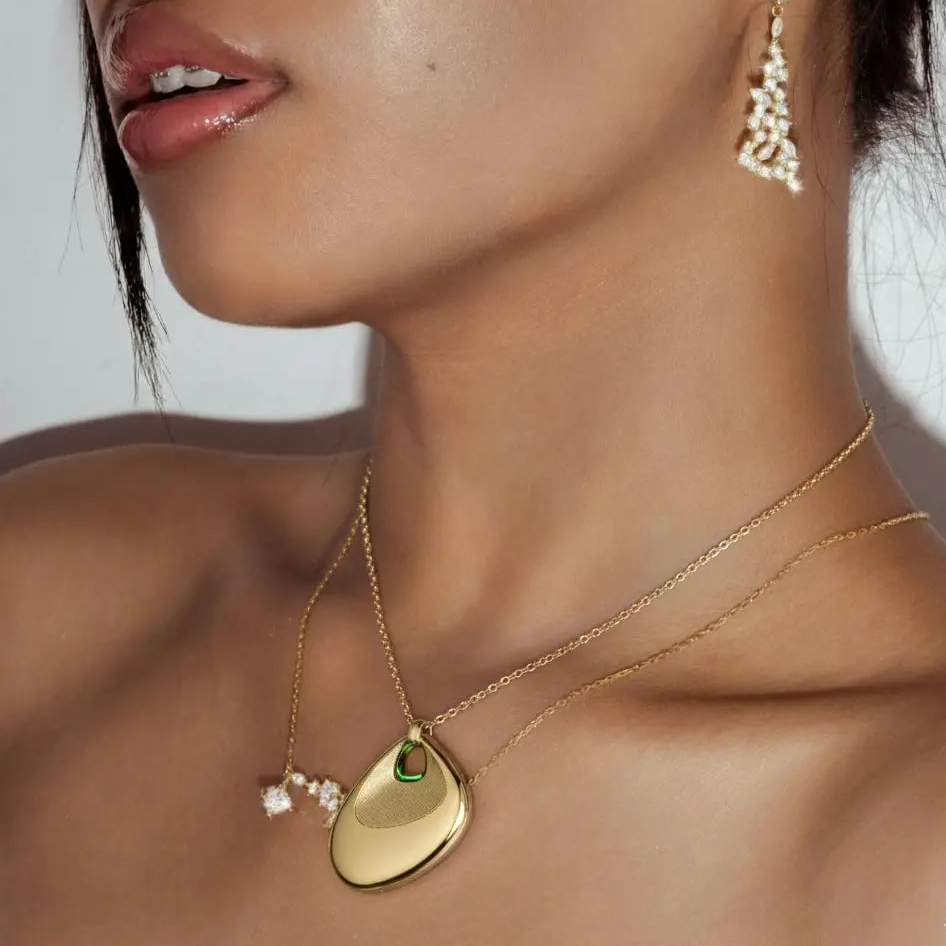
An AI necklace and an AI pendant are the same thing. Both describe a small microphone-based device worn around your neck that listens to conversations, converts them to text, and sends you transcripts, summaries, and to-dos through a phone app. Manufacturers almost always say pendant. Shoppers almost always say necklace. Neither is wrong, and no product exists that is a necklace but not a pendant. The differences worth caring about are elsewhere.
Why Are There Two Names for the Same Device?
The split comes from who is doing the talking.
Pendant is the industry word. It describes the object itself, the small hardware unit hanging from a cord. Limitless used it, Friend uses it, and most reviews follow that convention because that is what the press releases say.
Necklace is what people type into a search box. It describes the way the thing is worn rather than the thing itself, which is the more natural way to describe an unfamiliar product. If you have never seen one of these devices, you are far more likely to search for an AI necklace than an AI pendant, because you are describing the shape of what you want.
There is one narrow case where the words come apart. A few devices in this category are not neck-worn at all. Bee is a wristband or a clip. The Plaud NotePin is a pin that magnets to your shirt. Those are AI wearables, and they compete directly with neck-worn devices, but calling them a necklace would be wrong. If a guide lists them under AI necklaces without saying so, it is padding the list.
Which Devices Are Actually Worn Around the Neck?
| Device | Price | Worn as | Capture | Built for |
|---|---|---|---|---|
| Legend | $499, first year included | Neck cord, chest height | Always-on | ADHD and ambient memory |
| Friend 2.0 | $249 | Neck cord | Always-on | Companionship, not notes |
| Omi | ~$89 | Neck cord or head | Always-on | Developers |
| Limitless Pendant | Discontinued | Neck cord or clip | Always-on | No longer sold |
| Plaud NotePin S | $179 | Pin, clip, or wrist | Press to record | Meetings |
| Bee | $49.99 | Wristband or clip | Always-on | Cheapest entry point |
The top four are genuine neck-worn devices. The bottom two are the ones that get swept into necklace lists because they are popular, not because they hang from your neck.
Does Wearing It on Your Neck Actually Matter?
Yes, more than most product pages explain, and for a reason that has nothing to do with looks.
Chest height is roughly equidistant between your mouth and the mouth of whoever is standing in front of you. That geometry is why a neck-worn microphone tends to capture both halves of a conversation at similar volume. A wrist-worn device moves constantly, spends a lot of the day pointed at a table or hanging by your side, and picks up sleeve noise. A pin on your collar sits closer to your own mouth than to anyone else's, which is fine for dictation and less good for dialogue.
None of this makes clips or wristbands bad. It means the form factor is a choice about what you are trying to record. If the answer is conversations rather than your own voice, neck height is the position that was designed for it.
What Actually Separates These Devices?
Ignore the naming and look at three things.
Does it wait for you to start it? This is the biggest fork in the category. Always-on devices listen continuously so nothing gets missed. Press-to-record devices stay off until you trigger them. The first gives you complete coverage and a live microphone in every room. The second gives you clean boundaries and misses anything you did not anticipate. Whichever side of that you land on should decide your purchase before price does.
Does it keep the audio? Rarely advertised, and it is the question with the longest tail. Some devices store recordings you can play back. Others transcribe to text and discard the audio. The difference is whether you end up owning a searchable archive of recordings or a set of notes. That matters for security, for the twelve US states with all-party consent laws, and for how comfortable the people around you are.
Can people tell it is on? A device that gives no signal reads as deceptive whether or not it is legal. Visible indicators have quietly become the category norm for exactly this reason.
How Much Does an AI Necklace Cost?
Between roughly $89 and $499 for neck-worn devices specifically. Omi is around $89 and open source. Friend 2.0 is $249 and is a companion rather than a note-taker. Legend is $499 with the first year of membership included. Cheaper options exist in the wider AI wearable category, notably Bee at $49.99, but those are clips and wristbands rather than necklaces.
Watch the subscription line as closely as the sticker. Several devices in this category are priced low and recover it monthly, and at least one has had its fee waived only because the company was acquired. Add three years of subscription to each price before comparing anything.
Is It Worth Buying One?
Only if you have the specific problem it solves, which is narrower than the marketing suggests.
If you routinely lose information that was spoken to you, in meetings, at appointments, in the doorway on the way out, a device that captures conversation will change your week in a way that is hard to appreciate until it happens. If you mostly want meeting transcripts and can predict which meetings matter, a press-to-record clip does the job for a third of the price. If neither of those is a real problem for you, wait. Prices are falling and the software improves every quarter.
One more thing worth knowing before you spend anything. This category consolidates fast. Meta acquired Limitless in December 2025 and ended Pendant sales. Amazon acquired Bee in July 2025. Humane's AI Pin is gone entirely. Ask what happens to your transcripts if the company is bought, and whether the hardware still works if the service stops.
The Takeaway
Do not spend time deciding between an AI necklace and an AI pendant, because that is a vocabulary question rather than a product one. Spend it on the three that matter: whether the device waits for you to press it, whether it keeps your audio, and whether the people around you can see it running.
Legend answers those three deliberately. It is a voice-first AI pendant made for people with ADHD, worn at chest height where speech carries most reliably from both sides of a conversation. It transcribes in real time across more than 150 languages using three microphones, keeps no raw audio so what remains afterward is notes rather than recordings, and shows a Halo light whenever it is active. The day arrives as summaries and auto-generated to-dos in the Legend App on iOS and Android, with about two days of use from a two-hour USB-C charge. At $499 the first year of membership is included. It is the most expensive device on this page, and it is the right one only if the failure you are trying to fix is that remembering to press record is the exact step your brain skips.
FAQ
Is an AI necklace the same as an AI pendant? Yes. They describe the same category of device. Pendant is the word manufacturers use, necklace is the word shoppers use. No product is one and not the other.
What does an AI necklace do? It captures speech through a microphone worn at chest height, converts it to text, and returns transcripts, summaries, and action items through a companion phone app. Some listen continuously, others only when you press them.
How much does an AI necklace cost? Roughly $89 to $499 for neck-worn devices. Omi is around $89, Friend 2.0 is $249, and Legend is $499 with the first year of membership included. Factor in any subscription before comparing.
Do AI necklaces record everything you say? It depends on the device, and it is the most important question to ask. Some store audio files you can play back. Legend transcribes to text and stores no raw audio, and shows a Halo light whenever it is active.
Are AI necklaces legal? In most of the United States yes, under one-party consent. Twelve states require everyone in a conversation to agree. Devices that store no raw audio and show a visible indicator are designed around that, but check the rules where you live.
Share:
Samsung Galaxy Watch Ultra 2 vs Apple Watch Ultra 3: Which Should You Buy?
AI Pendant Subscription Costs: What You Actually Pay Over Three Years