


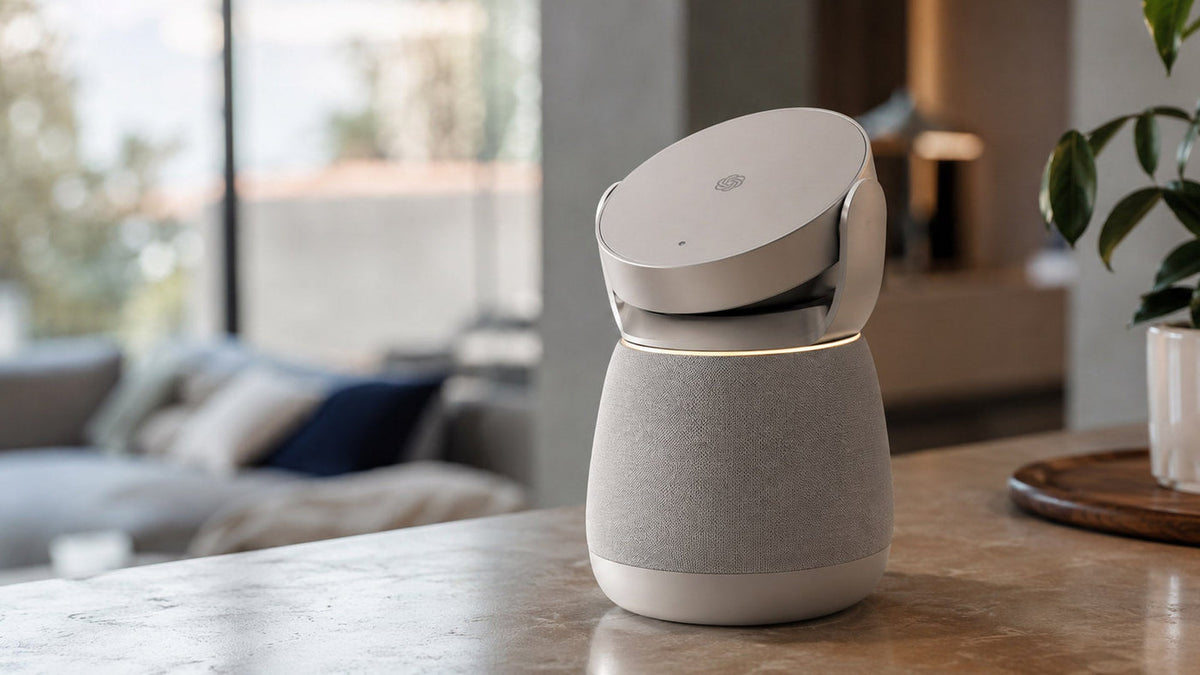
The AI hardware race just got its first big lawsuit, and it tells you a lot about where the whole industry thinks the future is headed.
What OpenAI is building
OpenAI is entering the hardware business, and its first consumer device is a screen-free smart speaker built to sit in your home and act like a humanlike AI companion. Developed in partnership with legendary former Apple designer Jony Ive and his LoveFrom studio, the device is portable, runs on a rechargeable battery so it can move from room to room, and is built around ChatGPT. Reporting says it will answer questions, control smart home appliances, play media, and even include a camera and sensors so it can perceive its surroundings rather than just listen for a wake word.
Internally, OpenAI reportedly does not even describe it as a speaker. The pitch is a new kind of home computer for the AI era, one whose defining feature is its personality and its ability to feel, in the company's framing, almost alive. An unveiling is targeted for later in 2026, with a commercial release expected in 2027, at a reported price somewhere in the $200 to $300 range.
Why Apple is suing
Here is where it gets dramatic. In mid-July 2026, Apple filed a lawsuit against OpenAI alleging trade secret theft, pointing to the many former Apple employees now working on OpenAI's hardware effort. Apple is reportedly seeking an injunction on OpenAI's hardware, which in theory could stall OpenAI's ability to sell the device at all. OpenAI has maintained that its speaker differs substantially from anything Apple sells and does not infringe on Apple's products, while Apple has acknowledged that discovery would be needed to prove its case.
The takeaway is not really about who wins. It is that two of the most powerful companies on earth are now fighting in court over the same prize: the AI device that sits at the center of your home and your life. When giants sue each other over a product category, it is a signal that everyone believes this is the next big platform.
The part everyone's missing
Step back from the courtroom drama and something becomes obvious. Look at what almost everyone in AI hardware is racing to build, and it is variations on the same idea. A box for your home. A companion that talks back. A device with cameras and microphones perceiving your space, running the whole show, meant to feel like a presence in the room.
There is a very different question hiding underneath all of it, and it is the one these products barely touch. Not "how do I put a talking computer in my house," but "how do I hold onto my own life." The names I forget, the ideas that slip away, the conversations that vanish, the ordinary things my memory keeps dropping. A speaker on the counter, however clever, does not solve that. It is built to answer questions and run your home, not to quietly remember your days for you.
A different kind of AI device
This is where Legend takes a deliberately different path from the home-speaker race.
Legend is not a box for your home. It is a memory pendant you wear, designed to quietly transcribe and summarize the moments of your day into searchable memory, without ever creating an audio file, so the things you would have forgotten are held for you. There is no camera watching the room, no companion trying to feel alive, no device sitting on a shelf perceiving your space. There is just a beautiful piece you wear at the collarbone, working quietly in the background, so that later, when you need to recall something, it is there.
The philosophical difference matters. The home speakers want to be a presence in your life, something you talk to, something that occupies the room. Legend wants to disappear, so that what stays present is your own memory. One adds another device to be aware of. The other takes the mental load of remembering off your shoulders and asks for none of your attention in return.
And because Legend was designed as jewelry first, in gold, silver, black, and rose gold, it is not a gadget at all in the way these speakers are. It is something you would actually want to wear every day, which is exactly what a memory device needs to be.
Where this is heading
The AI hardware wars are just getting started, and the lawsuits are a sign of how high the stakes have become. But it is worth remembering that "put an AI in your house" is only one vision of the future, and it happens to be the one everyone is crowding into at once.
The quieter, more personal vision is not a computer that lives in your home and talks back. It is a device that helps you hold onto your own life without demanding your attention, and then gets out of the way. While the giants fight over the living room, that is the space Legend is building in.
Share:
The Memory Device That Vanishes, So Your Memories Don't
Apple's AirPods Might Get Cameras. Here's the Bigger Story.