


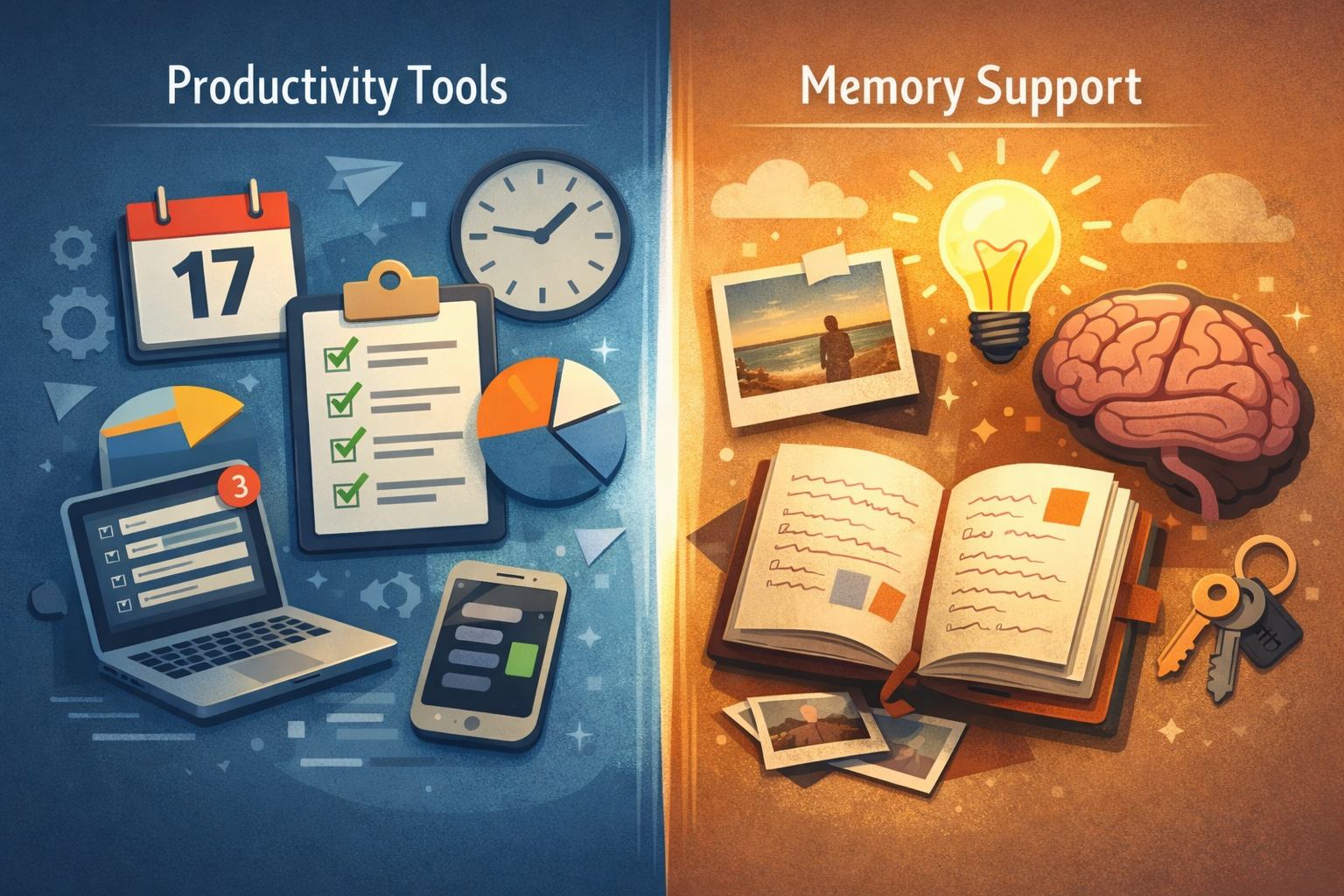
The assumption most tools make
Most productivity tools start from the same assumption.
If people just organize better, plan harder, or check in more often, things will work.
This assumes that the main problem is effort.
For many people, especially those with ADHD, the problem is not effort. It is interruption. Context loss. The mental overhead of constantly managing what comes next.
Productivity tools often increase that overhead.
More tools, more load
Task managers, reminders, and planning systems all require interaction.
Open the app. Decide where something belongs. Set a time. Choose a priority. Come back later.
Each step adds cognitive load.
Over time, people end up spending more energy maintaining the system than doing the thing itself.
What memory support changes
Memory support works differently.
Instead of asking people to structure their thoughts, it holds them.
Instead of pushing alerts, it allows rediscovery.
Instead of forcing decisions in the moment, it defers them until the brain is ready again.
This feels fundamentally different.
It replaces pressure with continuity.
Why this matters for ADHD
For people with ADHD, mental energy is precious.
Every decision to capture, sort, or schedule is a chance for momentum to break. When that happens, important things disappear.
Memory-first tools reduce those breaks.
They let people stay in motion while trusting that important ideas, conversations, and intentions will return later.
That trust is what reduces cognitive load.
Assistance, not optimization
Productivity tools optimize output.
Memory support tools protect continuity.
They are not trying to make people faster or more efficient. They are trying to make life feel less fragmented.
This difference is subtle, but once felt, it is hard to unfeel.
Why wearables amplify this effect
When memory support lives in a wearable, it asks for even less.
There is no app to open. No habit to maintain. No moment of friction.
The device is already there.
For ADHD, that reduction in effort is not convenience. It is access.
What to look for instead
When evaluating tools, the most useful question is not what features they offer.
It is how much mental work they remove.
Do they reduce decisions.
Do they hold context across time.
Do they stay quiet unless needed.
If so, they are likely supporting memory rather than competing with it.
A different category
Memory support is not a subset of productivity.
It is a different category entirely.
One focused on helping people carry less, not do more.
As AI wearables continue to evolve, this distinction will become more obvious.
And more important.
Share:
The difference between AI pendants and AI rings
The first known wearable device