


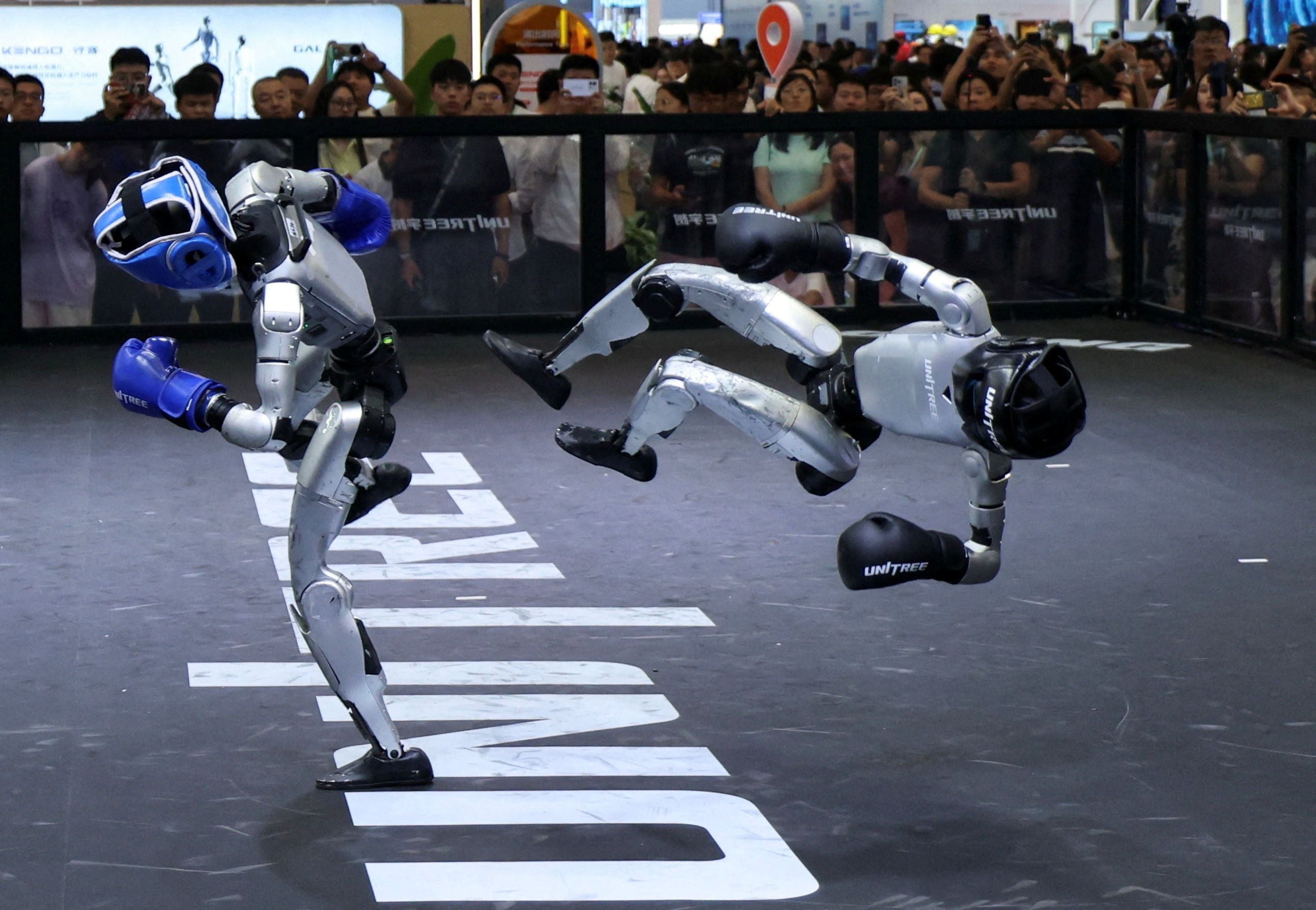
Unitree Robotics went public on Shanghai's STAR Market today and the result was the most violent listing of the year. Shares priced at 150.80 yuan opened at 1,100 yuan, a gain of 629%, then gave back nearly a quarter of that to close at 845 yuan, up 460%. That leaves the humanoid robot maker valued around 341.8 billion yuan, roughly $50 billion, at about 857 times projected 2026 earnings. The business underneath is real and growing fast. The price is a different question entirely.
What Happened in Unitree's Shanghai Debut?
Unitree, legally Yushu Technology Co. Ltd., raised 6.1 billion yuan (about $905 million) by floating roughly 10% of its expanded share capital. Retail demand was extraordinary: the offering was oversubscribed roughly 8,000 times. When trading opened, price discovery essentially broke, with shares vaulting to more than seven times the IPO price before sellers arrived.
The intraday chart tells the story better than any single number. The 23% slide from the 1,100 yuan peak to the 845 yuan close was the market arguing with itself in real time, on day one, about what a humanoid robot company is worth. Both figures are being reported as "the" gain depending on which moment an outlet measured, which is worth knowing if you see conflicting headlines.
How Big Is Unitree's Actual Business?
Bigger than most people assume, and unusually for a hype-cycle listing, profitable.
| Metric | 2024 | 2025 |
|---|---|---|
| Revenue | 393 million yuan | 1.70 billion yuan, up 333% |
| Adjusted net profit | 77.5 million yuan | 590.8 million yuan |
| Gross margin | 60.13% | |
| Overseas revenue share | 43.65% | |
| Humanoid units shipped | More than 5,500 |
Revenue more than quadrupled in a year. Gross margin above 60% is software-like, not the thin hardware margin most robotics companies live with. Nearly 44% of sales came from outside China, which matters because it means this is not purely a domestic industrial-policy story. And the company ships in volume: over 5,500 humanoids in 2025, with the H2 model listed around $29,900 and built with 31 powered joints.
For a category that has spent a decade producing spectacular demo videos and very few invoices, those are legitimately impressive numbers.
Is the Valuation Justified?
This is where honesty is required, and the most telling evidence comes from inside the deal.
CITIC Securities, the IPO's own sponsor, published pre-listing valuation guidance of 50.6 billion to 55.9 billion yuan. The stock closed at 341.8 billion. The bank that underwrote the offering valued the company at roughly an 85% discount to where the market ended day one. Sponsors are not known for lowballing their own clients.
The multiple compounds the point. Around 857 times projected 2026 earnings, against a STAR Market average near 130 times. Unitree would need to grow into that number at a pace that even its 333% revenue year does not obviously support, and it would need to do so while Figure, Tesla, Agility, and a dozen Chinese rivals are all racing at the same market.
None of that means the company is bad. It means the stock and the company are two separate things, and only one of them is currently trading at a price anyone can underwrite with a spreadsheet.
Why Does This Matter Beyond Robotics?
Because it is a hard financial signal in a field usually measured in demo reels. Public markets just assigned $50 billion to a company whose entire product thesis is that machines should perceive the physical world and act in it. That is the same thesis driving every AI wearable being built right now, running on largely the same component stack: compact sensors, edge inference, and power-efficient AI silicon.
When capital floods into embodied AI at this scale, the effects reach well past humanoids. Volume drives down unit costs on the exact parts wearable makers depend on. It pulls engineering talent into perception systems. And it gives every hardware founder pitching an ambient AI device a comparable to point at.
The timing was not accidental either. The debut landed during the World Robot Conference in Beijing, where hundreds of companies were demonstrating humanoids, industrial systems, and robot dogs. China now accounts for close to the entire global supply of humanoid robots. Unitree's listing is the financial expression of a manufacturing position that was already built.
We flagged this IPO when it was still just a filing in our wearable and AI hardware roundup earlier this month. The raise came in at the top of expectations and the reception exceeded them by a wide margin.
The Takeaway
The verdict: admire the company, be very careful with the stock. Unitree has done what almost nobody in humanoid robotics has managed, which is turn a research-grade category into a profitable business with real shipments and real export demand. That deserves the attention it is getting. But a 460% first-day close at 857 times earnings, against its own underwriter's guidance of roughly one sixth that valuation, prices in a decade of flawless execution before the decade has started. The 23% fade from the intraday peak suggests some buyers reached the same conclusion within hours.
The deeper signal is the one worth keeping. Investors just made an enormous bet that the next computing platform is a machine that senses the world around it rather than a screen you stare at. Legend is built on the same conviction, aimed at people instead of machines. Its pendant does not navigate a warehouse or throw a punch at a robotics expo. It listens to your day, transcribes conversations in real time, stores no raw audio, shows a Halo light whenever it is active, and turns what was said into summaries and auto-generated to-dos in the Legend App. Unitree is teaching machines to perceive the physical world so they can act in it. Legend is focused on perceiving your world so you do not have to hold all of it in your head, which for people with ADHD is the difference between a day that holds together and one that quietly falls apart.
FAQ
How much did Unitree stock rise on its first day? Shares opened at 1,100 yuan, up 629% from the 150.80 yuan IPO price, then closed at 845 yuan, up 460%. Both numbers appear in coverage depending on which point in the day is measured.
What is Unitree worth after the IPO? Roughly 341.8 billion yuan, about $50 billion, at the close. That works out to approximately 857 times projected 2026 earnings, versus a STAR Market average near 130 times.
Is Unitree profitable? Yes. The company reported 2025 revenue of 1.70 billion yuan, up 333% year over year, with adjusted net profit of 590.8 million yuan and gross margin above 60%.
What does Unitree make? Humanoid and quadruped robots. It shipped more than 5,500 humanoid units in 2025, with the H2 model priced around $29,900 and built with 31 powered joints.
Sources: Caixin Global: Chinese Robot Maker Unitree Soars 629% in Shanghai Debut; CNBC: China's backflipping robot maker Unitree pops in Shanghai debut; Semafor: Robotics giant Unitree's shares surge in Shanghai debut; TS2: Unitree stock soars in Shanghai debut as 857 times earnings valuation tests robot boom.
Share:
The Capture Gap: Why ADHD Productivity Systems Keep Failing at Step One
What Is an AI Wearable? How They Work, Types, and What They Are Good For