


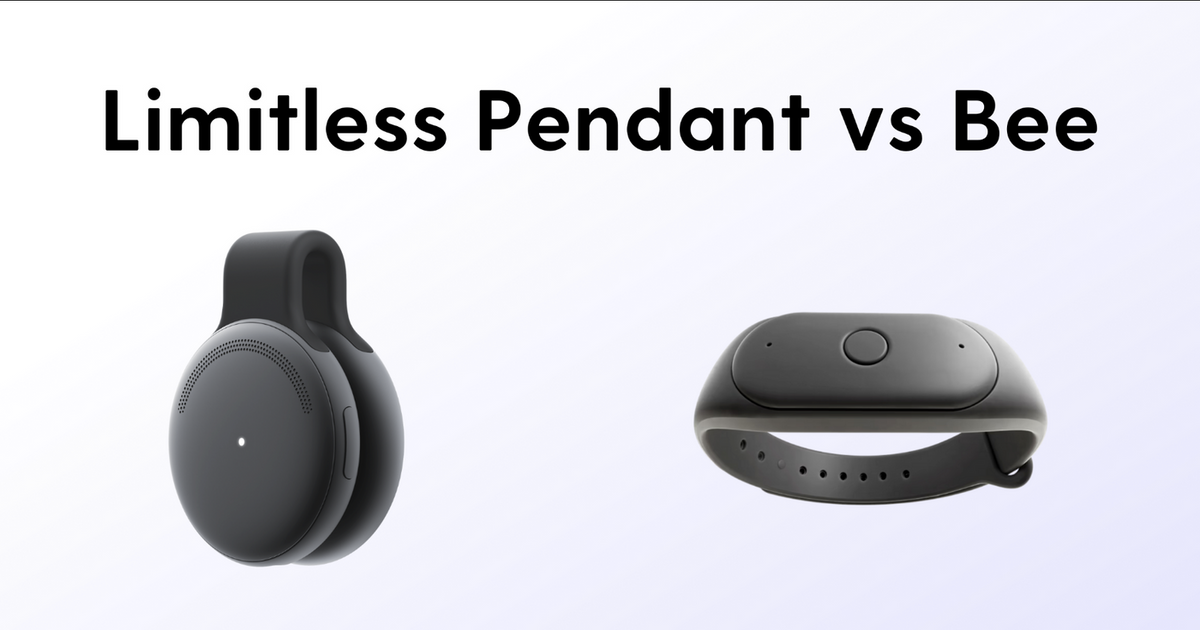
As voice-first computers and AI wearables have started to enter the mainstream conversation, two products have stood out as early explorations of memory-focused technology: Limitless and Bee.
Both were designed to listen, remember, and help people make sense of everyday conversations. Both were eventually acquired by much larger companies. And both took meaningfully different approaches to features, pricing, and positioning.
This piece looks at how Limitless and Bee compared before those acquisitions, focusing on what each product offered and how people experienced them.
What they were building
Limitless built a pendant-style AI wearable focused on capturing real-world conversations and turning them into searchable transcripts and summaries. The emphasis was on recall. Meetings, discussions, and spoken ideas that could later be revisited through an app.
Limitless positioned itself as a memory tool. Something that helped people remember what was said, when it was said, and what mattered most.
The company was later acquired by Meta and stopped selling new hardware following the acquisition.
Bee built what it described as a voice-first computer. A small device designed to listen throughout the day and create summaries, reminders, and daily memory logs from ambient conversation.
Bee leaned into the idea of companionship and continuity. Rather than focusing on specific meetings or moments, it aimed to capture the broader flow of a day.
Bee was later acquired by Amazon.
Core features
Limitless
Limitless focused on structured memory and recall.
Key features included:
-
Continuous or on-demand audio capture
-
Transcription of spoken conversations
-
AI-generated summaries and highlights
-
Searchable memory logs through a companion app
-
Integration with professional and personal workflows
The product was often used in work settings, meetings, or situations where recall and accuracy were especially important.
Bee
Bee focused on ambient memory and daily context.
Key features included:
-
Always-available voice listening
-
Daily summaries of conversations and moments
-
Automatic reminders and to-do extraction
-
A chronological memory timeline
-
A more narrative view of daily life
Bee emphasized ease and presence over precision. The goal was to remember broadly, not perfectly.
Pricing and access
Limitless pricing
Before its acquisition, Limitless kept its hardware price low and put the ongoing cost into a subscription.
-
Hardware was sold around the $99 range during preorders
-
AI features were gated behind a monthly subscription, often around $19 per month
-
Free tiers existed with limited usage
-
After the acquisition, existing users were transitioned to free access, and new sales stopped
This pricing reflected a more intensive, professional-grade use case.
Bee pricing
Bee positioned itself as far more accessible.
-
Hardware was sold at a much lower entry price, $49.99, published by Bee
-
Bee charged $19 a month before Amazon acquired it in July 2025. That fee has been reported as dropped, though Amazon has confirmed nothing and a Premium tier has been signalled without pricing, so Bee's current running cost is unknown rather than zero
-
The device was marketed as something anyone could experiment with
Bee’s pricing made it easier for casual users to try voice-first computing without a large upfront commitment.
Battery life and form factor
Limitless was designed as a pendant with a strong emphasis on durability and long recording sessions. Battery life was built to support extended use tied to meetings and workdays.
Bee focused on longer multi-day battery life and flexibility. The device could be worn or clipped in different ways and was designed to fade into the background of daily life.
Both prioritized simplicity, but with different assumptions about how and when people would use them.
Who they were for
Limitless generally appealed to:
-
Professionals with frequent meetings
-
People who needed accurate recall
-
Users who valued search, structure, and summaries
Bee generally appealed to:
-
Everyday users curious about voice-first technology
-
People interested in memory as a narrative rather than a record
-
Users who wanted something simple and low-friction
Neither approach was inherently better. They reflected different ideas about what remembering means.
What changed after acquisition
After being acquired by Meta, Limitless stopped selling new devices and focused on supporting existing users under updated terms.
Bee, after being acquired by Amazon, became part of a much larger ecosystem focused on voice assistants, AI, and ambient computing.
In both cases, the products themselves became less important than the ideas they introduced.
Looking at them together
Limitless and Bee represented two ends of an emerging spectrum.
Limitless treated memory as something to be captured, searched, and revisited with precision.
Bee treated memory as something to flow with daily life, quietly and continuously.
Both helped move the idea of voice-first, memory-focused technology forward. And both raised important questions about how people might want computers to support remembering in the future.
Share:
Amazon just acquired a voice-first computer
A guide to AI devices that transcribe your life