


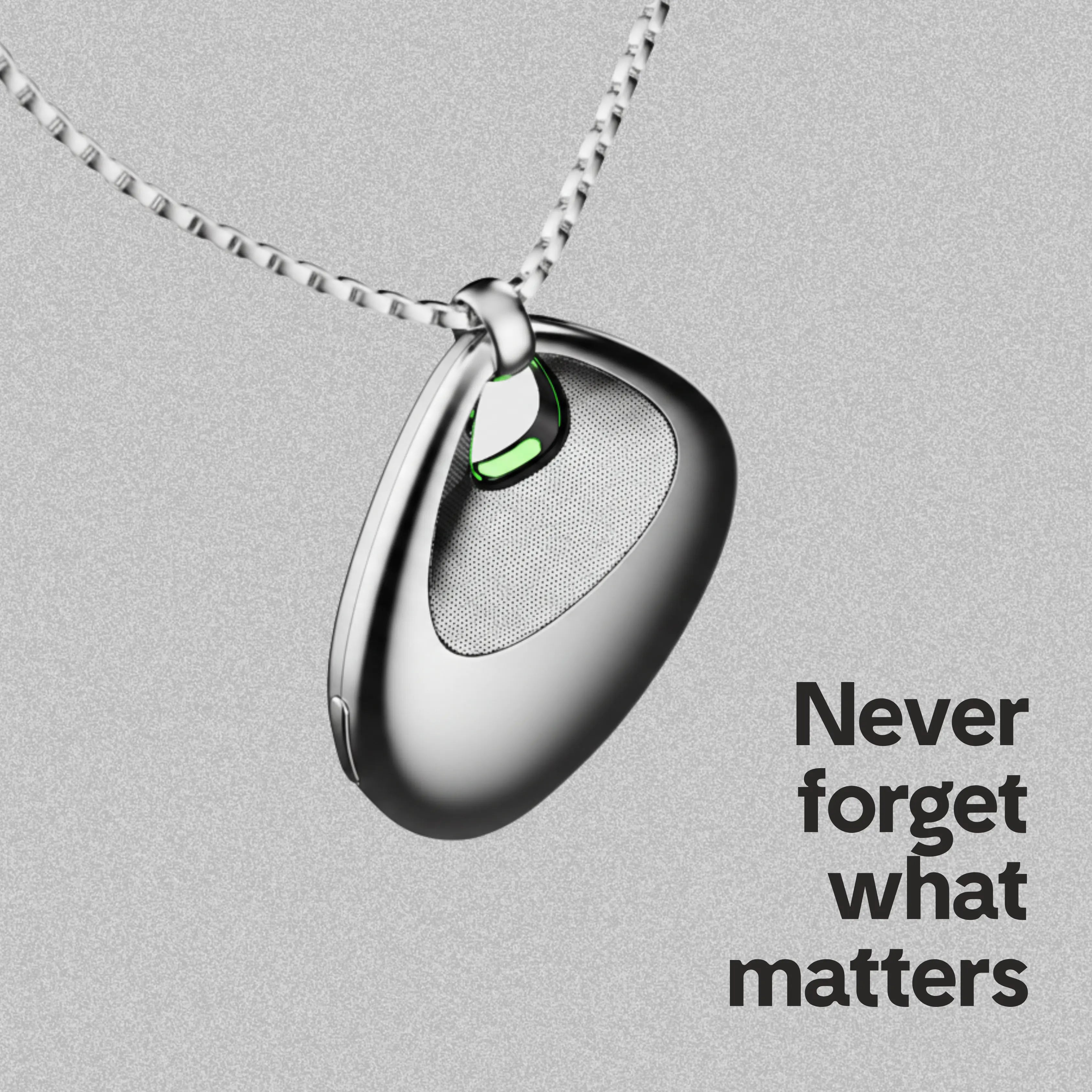
Legend is a voice-first AI pendant worn at chest height that listens to your conversations, converts speech to text as it happens, and turns the day into summaries and to-dos inside a companion app. It never stores raw audio. What survives a conversation is a transcript, not a recording, and a Halo light on the pendant shows the people around you when it is running.
What Happens When Someone Talks to You?
Four stages, and the second one is where Legend differs from most of the category.
Capture. Three microphones pick up speech from a few meters away. Chest height matters here and it is not a styling decision. It is roughly equidistant between your mouth and the mouth of whoever is in front of you, which is why a neck-worn microphone tends to hear both halves of a conversation at similar volume. A wrist device spends much of the day pointed at a table. A collar pin sits closer to you than to them.
Transcribe. Speech becomes text in real time, across more than 150 languages, with the microphones distinguishing between speakers so the transcript reads as a conversation rather than a wall of words.
Discard. The raw audio is not kept. This is the stage most devices skip, and it is the reason Legend's output is a set of notes rather than a library of recordings you could play back.
Deliver. The Legend App on iOS and Android shows live transcription as it happens, then assembles daily summaries and auto-generated to-dos from what was said.
Does Legend Record You?
It transcribes rather than records, and the distinction is the whole design.
A recorder produces an audio file. That file can be played, copied, subpoenaed, leaked, or handed to whoever buys the company. A transcriber produces text and lets the sound go. If someone got hold of your Legend history they would find what was said, which is not nothing, but they would not find the voices of everyone you spoke to that year.
This also matters legally, though the law has not caught up. Wiretapping statutes were written around intercepting and retaining audio, and a device that converts speech to text on the fly without keeping the file sits in genuinely different territory from one that stores playable recordings. Courts have not settled how those compare, because the hardware is newer than the case law. We went through the state-by-state rules in Are AI Wearables Legal?
Data is encrypted at rest and in transit, and you can delete any single conversation or your entire history from the app.
How Do People Around You Know It Is On?
The Halo light. When Legend is actively transcribing, it shows.
That sounds like a small feature and it is doing heavy lifting. The reason Google Glass failed in 2013 was not the computing, it was that nobody nearby could tell what it was doing, so they assumed the worst. Every workable design in this category since has had to answer that objection, and a visible indicator is the cheapest honest answer available. It converts the device from something that might be listening into something that is visibly either on or off.
The social side of wearing one is a separate skill from the hardware, and we covered it properly in Is It Creepy to Wear an AI Pendant?
Do You Have to Turn It On?
No, and this is the design decision everything else follows from.
Most devices in this category wait for a press. That is defensible: cleaner privacy, clearer boundaries, cheaper to run. It also assumes that at the moment a conversation turns important, you will notice, remember the device exists, and act on it.
For a lot of people that assumption holds. For people with ADHD it frequently does not, because noticing and acting in the moment is precisely the function that is unreliable. Capturing a note is itself a prospective memory task, which means a press-to-record device asks you to use the system that is failing in order to compensate for the system that is failing.
Legend runs continuously so that step does not exist. The trade is that you are wearing a live microphone, which is why the no-stored-audio design and the Halo light are not add-ons. They are what make continuous capture something you can wear in front of other people.
What Do You Actually Get Back?
Transcripts of what was said, daily summaries of it, and to-dos pulled out automatically. You can search it and ask plain questions rather than navigating folders, which matters because remembering where you filed something is the same failing function again.
Worth being clear about scope. Legend captures conversations. It is not a note-taking app for your own written thinking, an idea inbox, or a reference library. It handles the specific failure of information arriving by speech and not surviving the day.
The Practical Details
| Spec | Detail |
|---|---|
| Worn | Pendant, at chest height |
| Microphones | Three, speaker-distinguishing |
| Languages | 150+ |
| Audio storage | None, transcripts only |
| Active indicator | Halo light |
| Battery | 2 days continuous, 5 days standby |
| Charging | About 2 hours, USB-C |
| App | The Legend App, iOS and Android |
| Water resistance | Splash-resistant, not waterproof |
| Security | Encrypted at rest and in transit |
| Finishes | Gold, Brushed Silver, Matte Black |
The Takeaway
The way to understand Legend is by what it refuses to do. It refuses to wait for you, because waiting is where capture breaks for the people it was built for. And it refuses to keep the audio, because an archive of recordings is a liability rather than a feature once you have the text.
Those two refusals pull against each other, which is the interesting part. Continuous capture usually means a bigger archive. Not keeping audio usually means capturing less. Doing both is the specific problem Legend is built around: a pendant made for people with ADHD that runs all day, hands back summaries and to-dos in the Legend App, and leaves nothing behind but the words. Membership covers unlimited transcription and storage, and the first year is included at $499.
FAQ
How does the Legend AI pendant work? Three microphones capture speech at chest height, it is transcribed to text in real time across 150+ languages, the raw audio is discarded, and the Legend App turns the result into daily summaries and auto-generated to-dos.
Does Legend store recordings? No. It transcribes speech to text and keeps no raw audio, so what exists afterwards is a transcript rather than a playable recording.
How long does the Legend battery last? Up to two days of continuous use or five days on standby, from roughly a two-hour USB-C charge.
Do you have to press anything to start Legend? No. It transcribes continuously rather than waiting to be triggered, which is the point for people who would forget to press it. The Halo light shows when it is active.
Is Legend waterproof? It is splash-resistant, not waterproof.
Share:
The ADHD Second Brain: Why Note-Taking Systems Fail and What Actually Works
Where Are Meta Smart Glasses Banned? The Growing List, and Why Meta Is Building a Pendant Instead