


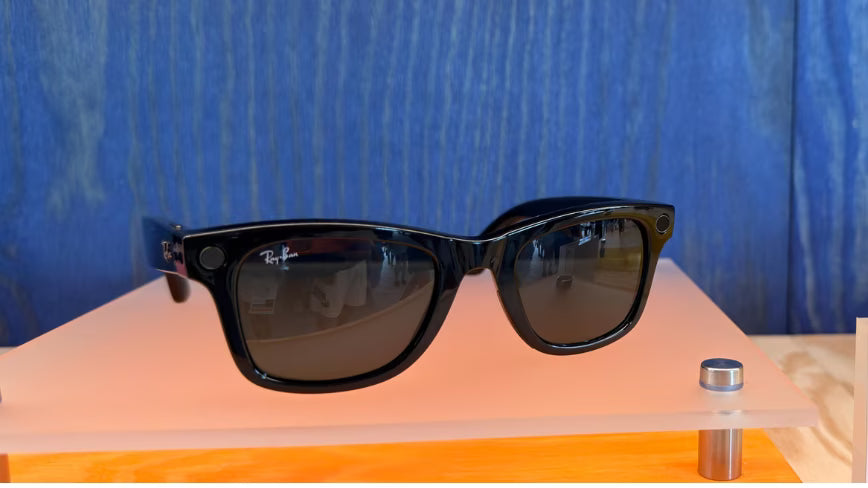
Meta smart glasses are now barred from US federal immigration offices, UK cinemas, school districts in three states, courts in New York and in England and Wales, and the South Korean exam hall. The Meta Ray-Ban Display cannot launch in the European Union at all. Every one of those restrictions names the same component, and it is not the microphone. It is the camera. Which makes Meta's next reported device, a pendant with no camera at all, look less like a new product line and more like an answer to the last two months.
Who Has Actually Banned Meta Smart Glasses?
| Who | What they did | When |
|---|---|---|
| ICE | Barred all employees from wearing them at work | August 19, 2026 |
| UK Cinema Association | Restricted camera eyewear across member cinemas | August 20, 2026 |
| School districts in Florida, California, Nevada | Explicit bans after harassment cases | August 2026 |
| New York State | First US state to bar them from court buildings | July 2026 |
| Courts in England and Wales | Followed New York | August 2026 |
| DEF CON 34 | Asked attendees to leave recording glasses at home | August 2026 |
| US Air Force | Unauthorised in uniform | 2026 |
| South Korea | Restricted in exam halls | 2026 |
| Soho House, Wetherspoons, NBA arenas | Venue-level bans | 2026 |
| European Union | Ray-Ban Display cannot launch, battery rules and AI regulation | 2026 |
Philadelphia, Hawaii and North Carolina have narrower court restrictions. Cork city libraries wrote smart glasses into their bylaws. Monopoly Events banned camera glasses from its Comic-Cons after complaints about secret filming. A UK government petition calls for banning their sale and promotion outright, and an Irish campaign to ban them launched on August 21.
What Are Regulators in Europe Actually Doing?
Moving slowly and in the same direction. The European Data Protection Board is drafting a report on smart glasses, expected within months, which is the step that usually precedes coordinated action. Germany's data protection authority has warned the glasses could fall foul of existing law prohibiting concealed recording devices, which is a sharper threat than a new rule because it needs no legislation. France's privacy regulator has flagged the risks. Dutch digital rights groups have been vocal.
Meanwhile the Ray-Ban Display simply cannot be sold in the EU, blocked by a combination of battery regulations and AI rules. Whatever you think of that outcome, the practical effect is that Meta's flagship wearable is unavailable in one of the world's largest consumer markets.
Why Is It Always the Camera?
Read the stated reasons and the pattern is unmistakable. ICE cited devices that "could unintentionally capture, record or transmit sensitive information." The UK Cinema Association cited film piracy and customer privacy, updating a policy it originally wrote in 2014 for Google Glass. The school bans followed documented cases of boys filming girls without consent.
Not one of these is about a device hearing something. They are about a device seeing something, and about the people nearby having no way to know whether it is.
That distinction matters commercially. A microphone captures what is said to you, which you were part of anyway. A camera captures people who never entered the conversation, in rooms where the recording norms are already settled, and it captures them in a form that travels. A transcript of a cinema screening is worthless. A video of it is piracy. A transcript of a school corridor is awkward. Video of a classmate is harassment.
The cinema policy dating to 2014 is the tell. Institutions worked out their position on camera eyewear during Google Glass. They are not forming a new opinion, they are enforcing an old one against a product that finally sold in volume.
So Why Is Meta Building a Pendant?
Meta is reportedly developing an AI pendant, per an internal memo reported by The Information in May 2026, with testing planned within the following year. It builds on Limitless, the AI pendant company Meta acquired in late 2025 to, in its words, accelerate work on AI-enabled wearables.
Details are thin and nobody should pretend otherwise. No specs, no price, no confirmed form factor. But the strategic logic reads clearly against the backdrop of this list. Meta has a wearables business that works and a component that keeps getting it thrown out of rooms. A pendant is the same ambient AI proposition with the offending part removed.
That is not a retreat. It is Meta arriving at the conclusion the rest of the category reached earlier, which is that audio-only wearables go places camera wearables cannot. Plaud, Bee, Omi and Limitless itself all made that choice years ago, and none of them appear on any ban list.
Does This Mean Smart Glasses Are Finished?
No, and predicting that would be silly. Ray-Ban Meta has sold in real volume and the glasses do things no pendant can, from translating a menu to identifying a landmark to capturing your own point of view. There is genuine demand for a camera on your face.
What is happening is narrower and more interesting. The market is discovering where camera wearables are welcome and where they are not, and that boundary is being drawn by cinemas, schools, courts and employers rather than by legislatures. Those institutions move faster than lawmakers and their decisions stick.
The likely equilibrium is not a ban but a split. Glasses for tasks that need vision, worn in places that permit them. Audio-only wearables for everywhere else, because a device that cannot see is a device nobody has to write a policy about.
The Takeaway
If you are buying a wearable and want it to still be usable in a year, buy for the boundary rather than the spec sheet. Ask where the device is welcome. Camera wearables are being restricted in exactly the places most people spend their days: workplaces, schools, venues, courtrooms. Audio-only devices are not on any of these lists, and that is not luck. It is the same reason the bans exist.
Three design choices separate a device people tolerate from one that gets written into a bylaw: whether it has a camera, whether it stores what it captures, and whether the people nearby can tell it is running. Legend answers all three deliberately. No camera. No raw audio kept, only transcripts, so what remains is notes rather than recordings. And a Halo light that shows when it is transcribing, which is the objection Google Glass never answered and every institution on the list above is still reacting to. It is a voice-first pendant made for people with ADHD, worn at chest height, transcribing in real time across more than 150 languages into summaries and to-dos in the Legend App. Built for the room you actually have to walk into.
For the etiquette side of wearing one, see Is It Creepy to Wear an AI Pendant?, and for the legal side in the US, Are AI Wearables Legal?
FAQ
Where are Meta smart glasses banned? Restrictions include ICE offices, UK cinemas, school districts in Florida, California and Nevada, court buildings in New York and in England and Wales, South Korean exam halls, DEF CON, and venues including Soho House, Wetherspoons and NBA arenas. The Meta Ray-Ban Display cannot launch in the EU.
Why are smart glasses being banned? Almost every restriction cites the camera rather than the microphone, on grounds of covert recording, harassment, piracy or exposure of sensitive information. Bystanders have no reliable way to tell whether they are being filmed.
Are Meta smart glasses illegal in Europe? Not illegal, but heavily constrained. The Ray-Ban Display cannot be sold in the EU, the European Data Protection Board is drafting a report on smart glasses, and Germany's data protection authority has warned they may breach existing rules on concealed recording devices.
Is Meta making an AI pendant? Reportedly yes. An internal memo reported by The Information in May 2026 described an AI pendant building on Limitless, which Meta acquired in late 2025, with testing planned within the following year. No specs or pricing have been announced.
Are AI pendants banned anywhere? They do not appear on these lists. The restrictions target camera-equipped eyewear specifically, and audio-only wearables have so far not attracted the same institutional response.
Sources: TNW: Cinemas, schools and ICE are all banning Meta smart glasses; TechRadar: Could Meta Ray-Bans be banned in Europe?; TechCrunch: Meta is reportedly developing an AI pendant; The Irish Times: New campaign aims to ban smart glasses. Image via TNW.
Share:
How Does the Legend AI Pendant Work? From Conversation to Daily Summary
A Day With Legend: What the AI Pendant Actually Changes for ADHD