


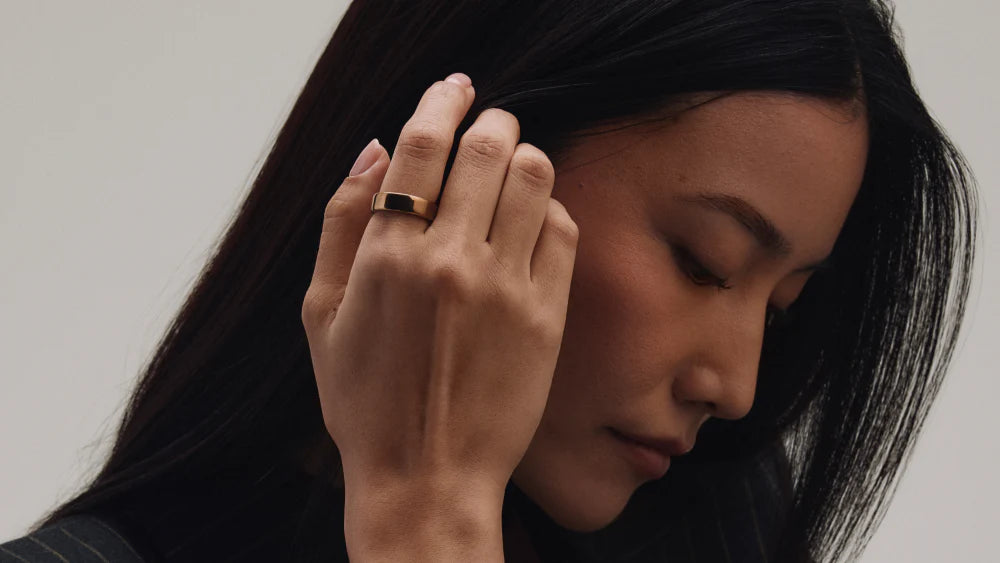
Every so often a product comes along that quietly changes what people expect from the things they wear. Oura did that for health. It took something that used to mean a chunky screen strapped to your wrist and turned it into a discreet band that looks like jewelry, and in doing so it got millions of people to track their bodies around the clock. Legend is built on the same insight, pointed at a different problem. Where Oura quietly tracks your body, Legend quietly keeps your memory. In a real sense, Legend is Oura for memory.
What Oura got right
Before Oura, the wearables market mostly assumed you had to choose between useful and wearable. Fitness trackers were capable but bulky, screen-first, and, for a lot of people, too unattractive to wear to everything from the gym to a wedding. Oura made a different bet: that the best tracker is the one you actually keep on, so the design has to be something you want to wear.
So it built a ring. No screen, no straps, no buzzing notifications. Just a minimal titanium band that looks like jewelry and disappears into your everyday style, even alongside other rings. And that design choice turned out to be the whole ballgame. Because it is comfortable and attractive, people wear it constantly. As reviewers keep noting, you barely think about it, and soon you forget it is even there. That is precisely what makes the passive tracking work: 24/7 data only happens if the device is on your body 24/7, and that only happens if you love wearing it.
The lesson Oura proved is simple but profound. For an always-on wearable, beauty is not a nice-to-have. It is the feature that makes every other feature possible.
The same insight, applied to memory
Legend takes that exact lesson and applies it to a different human problem: not your health, but your memory. The things you forget, the name, the plan, the idea, the conversation, are every bit as much a daily struggle as sleep or stress. And solving them requires the same thing Oura figured out: a device you will actually wear all day, every day, without thinking about it.
So Legend is a memory pendant, designed as jewelry first. It sits at the collarbone the way a fine piece belongs there, in finishes like gold, silver, black, and rose gold. It has no screen and no notifications clamoring for your attention. It is meant to be something you would happily wear anyway, so that it disappears into your life the way an Oura ring does. And while it is quietly disappearing, it does its work: transcribing and summarizing the moments of your day into searchable memory, without storing the raw audio, so the things you would have lost are held for you.
The parallel runs deep. Oura is screen-free; so is Legend. Oura works passively in the background; so does Legend. Oura only delivers because you keep it on, and you keep it on because it is beautiful; the exact same logic is what makes Legend work. Both took a category that used to look like a gadget and made it into something you wear because you want to.
Two ambient companions, two different signals
The neat thing is that Oura and Legend are not competitors. They are complements, two ambient wearables quietly capturing two different streams of your life.
Oura captures your body's signals, sleep, readiness, recovery, and turns them into insight about your health. Legend captures the substance of your days, conversations, ideas, plans, and turns them into memory you can search. One helps you understand how you are doing. The other helps you hold onto what happened. Worn together, they cover two of the things people most wish they could keep a handle on, and both do it the same way: passively, beautifully, and without ever asking for your attention.
Why this is the model that wins
Oura showed that the winning form for an always-on wearable is the one that looks so good you forget you are wearing it. That is not a marketing flourish; it is the reason Oura succeeded where bulkier trackers stalled. Legend is a bet that the same principle will define the next category of wearables, the ones built around memory rather than health.
The devices that win the day will not be the ones with the most sensors or the flashiest hardware. They will be the ones you actually keep on, because they are beautiful enough to belong in your life. Oura proved it for your body. Legend is proving it for your memory.
Share:
Kylie's Meta Glasses and Snap's Specs Just Launched. Here's What They're For.