


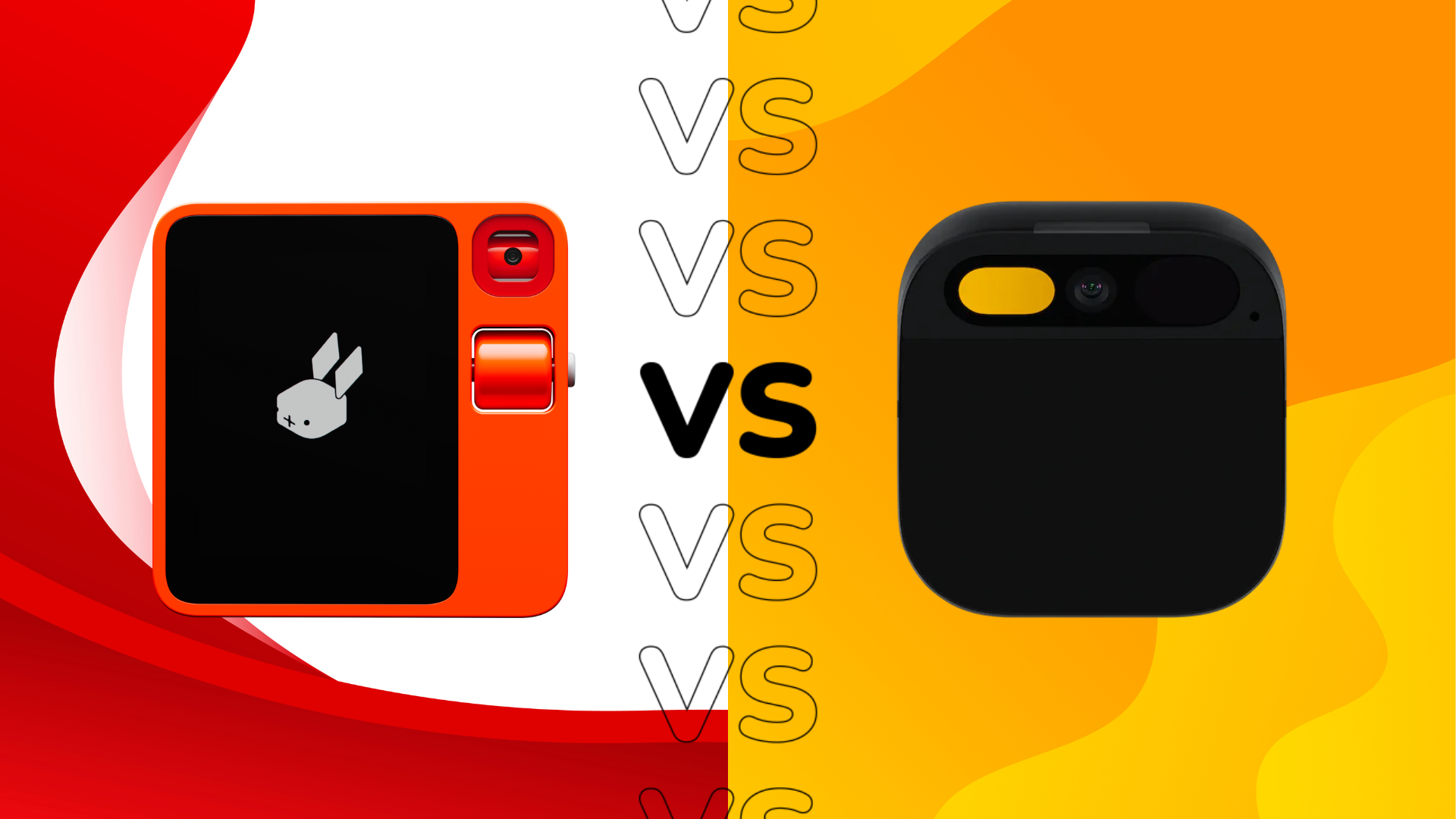
As artificial intelligence moves out of phones and into new forms, two of the most talked-about early attempts at reimagining everyday computing were the Rabbit R1 and the Humane AI Pin.
Neither device became a mainstream fixture, but both were ambitious in different ways. Comparing them helps clarify two very distinct approaches to wearable AI: one that leaned into screen-enabled, location-aware computing, and one that leaned into screenless, voice-first interaction.
This piece looks at how these devices were designed, how they worked, and what each revealed about the future of AI wearables.
What each device was
Rabbit R1
The Rabbit R1 was a wearable designed to blend AI assistance with visual context. It featured a small screen and camera, and it was meant to offer information, navigation, and contextual awareness without a phone.
The idea was not just voice responses but visual augmentation tied to the environment. The device could show information about places nearby, identify objects, translate signs, and offer answers in context.
In essence, Rabbit envisioned a future where AI could bridge the physical and digital worlds with minimal friction.
Humane AI Pin
The Humane AI Pin took a different first principle.
Instead of a screen, it focused on voice and projection. The goal was to provide AI answers, summaries, and assistance without demanding that the user look at a display.
Humane positioned interaction around natural language and glance-free information, with the idea that technology should fade into the background rather than pull attention forward.
Both devices offered a new way of thinking about how AI could live with people throughout a day.
Design and interaction
Screen vs screenless
One of the core differences between these devices was the presence of a screen.
Rabbit R1 included a screen as a central part of interaction. Visual context was part of its value proposition. It let people see answers, overlays, and real-time annotations.
Humane AI Pin did not rely on a screen at all. It used voice and optional projection to share information. The interaction model assumed that visual attention should be minimized.
This distinction reflects two underlying philosophies:
-
Screens as context bridges
-
Screens as attention anchors
Rabbit embraced context bridges. Humane tried to move away from anchors.
How they captured and used context
Rabbit R1
The Rabbit R1 used its camera and sensors to understand what was around a person. It could recognize landmarks, read text, and offer visual responses that matched the environment.
This made it useful for:
-
Translations
-
Navigation
-
Object recognition
-
Contextual visual guidance
In Rabbit’s model, context came from what the device could see and display.
Humane AI Pin
Humane’s approach to context was different.
It relied on voice and natural language, using input from speech and minimal visual cues like projection to respond. Context was built through conversation, intent, and ongoing interaction, not through visual scene analysis.
This made Humane’s model feel more like an assistant rather than an extension of sight.
Where each device lived
Rabbit R1
With a screen and camera, the R1 was most comfortable in moments where looking at information was helpful. It was a wearable computer, not a passive device.
It invited the user to glance, read, and interact visually.
Humane AI Pin
Without a screen, Humane’s device was designed to be less about looking and more about listening and speaking.
It was for situations where information could be delivered without drawing the user into a visual interface.
What their ambition revealed
Rabbit R1 showed
-
AI that understands visual context
-
Wearables as extensions of perception
-
A future where information is layered onto the world
Humane AI Pin showed
-
AI that operates without screens
-
Voice as a first-class interface outside phones
-
The possibility of computing that stays in the background
Both devices asked similar questions.
Where should intelligence live.
How much attention should it demand.
How should context be captured.
They just answered them differently.
What to take away
Neither Rabbit nor Humane delivered a finished vision of the future.
But both were meaningful experiments.
Rabbit reconnected computing to vision and place. Humane reconnected computing to conversation and attention.
Together, they expand the space. They make it easier to see that AI wearables are not one thing. They are many.
Share:
AI assistance devices and ADHD. What actually helps
What happened to Humane