


Yes, AI wearables are legal to use in the United States, but where you live changes what you can capture. Federal law under 18 U.S.C. 2511 follows a one-party consent standard, meaning you can record a conversation you are part of. Twelve states go further and require everyone present to agree. If you are wearing an always-on device in California, Illinois, or Florida, that distinction matters more than any spec on the box.
Which States Require Everyone to Consent?
Twelve states use an all-party consent standard: California, Connecticut, Delaware, Florida, Illinois, Maryland, Massachusetts, Montana, New Hampshire, Oregon, Pennsylvania, and Washington. Everywhere else follows the federal one-party rule, where your own participation in the conversation is enough.
Several of those twelve are messier than a simple label suggests. Connecticut requires all-party consent for phone recordings but follows one-party consent for in-person conversations under its criminal statute. Oregon inverts that, demanding all-party consent for in-person speech while allowing one-party consent for electronic communications. Illinois rewrote its law in 2014 after the previous version was struck down, and now explicitly permits recording law enforcement and public officials in public settings.
None of this is legal advice, and the rules shift. If you are in a regulated profession or handling anything sensitive, ask a lawyer rather than a blog.
Does an AI Pendant Count as Recording?
This is the question the statutes were not written for, and the answer depends on how the device works.
Wiretapping laws were drafted around the interception and retention of audio. A device that captures sound, converts it to text on the fly, and never keeps the audio file occupies genuinely different territory from one that stores a recording you can play back. Whether courts treat those two the same has not been settled, because the hardware is newer than the case law.
What that means practically: the design choice a manufacturer makes about audio storage is not a marketing detail. It is the difference between owning a searchable archive of recordings and owning a set of notes.
How Do the Major AI Wearables Compare on Privacy?
| Device | Capture | Audio kept? | Visible indicator |
|---|---|---|---|
| Legend | Always-on | No, transcripts only | Halo light when active |
| Plaud NotePin S | Press to record | Yes | Manual, you start it |
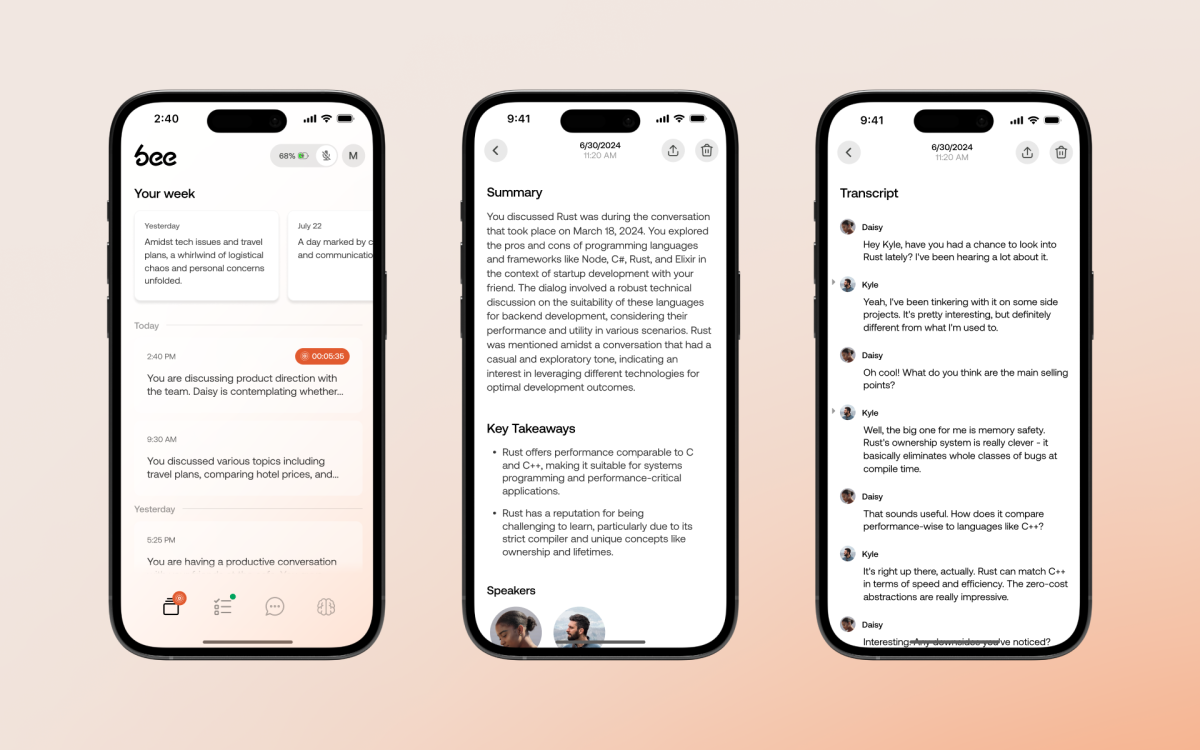
| Bee | Always-on | Yes | Limited |
| Sandbar Stream | Press and hold | Processed to notes | Mic off by default |
| Friend 2.0 | Always-on | 30-day memory window | Limited |
| Ray-Ban Meta | Camera and mic | Yes, captures media | Capture LED |
Two variables do most of the work here. Does the device wait for you to trigger it, and does it hold onto raw audio afterward. A press-to-record device with stored audio gives you clean legal footing on consent, because you chose the moment, but leaves you holding files. An always-on device that stores nothing inverts that: continuous coverage, no archive to subpoena or leak.
What About the People Around You?
The legal question and the social one are not the same, and the social one comes up far more often.
Google Glass failed in 2013 less because of any statute than because people disliked being near it. A device that gives no sign it is running reads as deceptive whether or not it is lawful. This is why visible indicators have quietly become the category standard: Ray-Ban Meta uses a capture LED, Apple is reportedly weighing an indicator for its camera AirPods, and Legend uses a Halo light that shows when it is transcribing.
The practical etiquette is simpler than the law. Mention it once when you meet someone. In every jurisdiction, saying "I wear this thing, it takes notes for me" resolves both the legal question and the awkward one, and takes about four seconds.
The Takeaway
Buy with the map in mind. If you live in one of the twelve all-party states, favor a device that either waits for you to press it or does not retain audio, and get in the habit of a one-line disclosure. If you are in a one-party state, your exposure is much lower and the decision comes down to what you actually want captured. Either way, the two questions worth asking any manufacturer are whether raw audio is stored and whether the device shows people when it is on. Vague answers on either point are the real red flag.
Legend was designed around both. It transcribes conversations in real time and keeps no raw audio, so what exists afterward is a set of notes rather than a library of recordings, and its Halo light makes clear when it is working. Data is encrypted at rest and in transit, and you can delete any conversation or your whole history from the Legend App. For people with ADHD, the trade-off that usually decides it is that a device which waits to be switched on is a device that gets forgotten, and Legend is built so the capture never depends on remembering.
FAQ
Is it legal to wear an AI pendant that records conversations? In most of the US, yes. Federal law and 38 states follow one-party consent, so participating in the conversation is enough. Twelve states require all parties to agree.
Which states require all-party consent? California, Connecticut, Delaware, Florida, Illinois, Maryland, Massachusetts, Montana, New Hampshire, Oregon, Pennsylvania, and Washington, with some variation between phone and in-person rules.
Do AI wearables store your audio? It varies and it is the key question to ask. Some keep audio files. Legend transcribes to text and stores no raw audio.
Do I have to tell people I am wearing one? Legally it depends on your state. Practically, a brief mention resolves both the legal and social issue, and devices with a visible active indicator make that easier.
Sources: Recording Law: Two-Party Consent States; Cornell Law School: 18 U.S.C. 2511.
Share:
Best AI Wearables 2026: Ranked by What You Are Actually Trying to Solve
Best AI Pendant 2026: Every Model Compared, and Which to Buy